



TL;DR: Data center security is a multi-layered discipline covering physical access controls, network segmentation, workload hardening, identity management, data protection, and continuous monitoring. Effective security requires treating the data center as a stack—not a single perimeter—and adopting a Zero Trust architecture that assumes no user, device, or workload is inherently trustworthy, even inside the network.
Picture this: an attacker doesn’t detonate a payload at your network edge. They walk in through a vendor access portal, move quietly between workloads, and spend 197 days inside your environment before anyone notices. By then, the damage is done.
This reality makes data center security one of the most consequential challenges in enterprise IT. The perimeter mindset—build a wall, keep attackers out—was never sufficient. Inside most data centers, once you’re in, you’re in. Traffic flows freely between servers, workloads communicate without challenge, and lateral movement goes undetected until it’s far too late.
According to the IBM Cost of a Data Breach Report 2025, the global average cost of a data breach is $4.44 million. For U.S. organizations, that figure climbs to $10.22 million. The Microsoft 2024 Digital Defense Report found that 80% of organizations have attack paths that expose critical assets—and 40% of those paths involve lateral movement between workloads.
This pillar page covers everything enterprise security leaders and IT architects need to know about data center security: what it is, how to architect it, which threats to prioritize, and how to build a defensible environment in a hybrid world.
What Is Data Center Security?
Data center security encompasses the physical controls, network architectures, software systems, operational processes, and compliance frameworks used to protect a data center’s infrastructure, data, and workloads from unauthorized access, service disruption, and data loss.
The key insight—one that many organizations miss—is that data center security is a stack, not a single wall. Hardening one layer while leaving others exposed creates exactly the kind of gap that sophisticated attackers exploit.
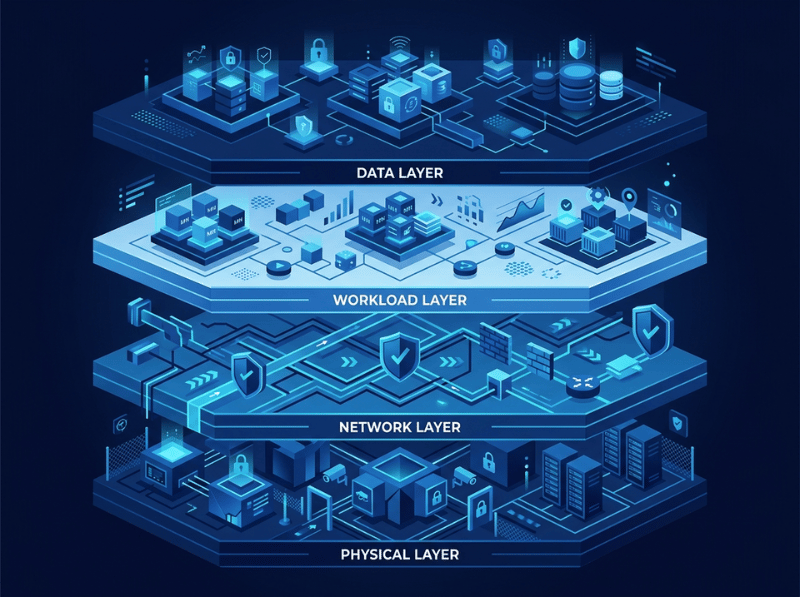
A useful model for thinking about data center security breaks it into four layers:
|
Layer |
What It Covers |
Example Controls |
|---|---|---|
|
Physical |
Facilities, hardware, and environmental systems |
Biometric access, man-traps, CCTV, anti-ram barriers |
|
Network |
Traffic flows, segmentation, perimeter, and internal controls |
NGFWs, IDS/IPS, microsegmentation, Zero Trust policies |
|
Workload |
Servers, VMs, containers, applications |
OS hardening, patch management, container security, and configuration baselines |
|
Data |
Information at rest, in transit, and in use |
Encryption, key management, data classification, and immutable backups |
Each layer reinforces the others. A failure at one creates a vector that attackers can exploit regardless of how well the other layers are implemented.
Why Data Center Security Matters for Modern Enterprises
What is the business cost of inadequate data center security?
Data centers are the operational core of most enterprises. They house customer data, proprietary intellectual property, financial records, and the applications that keep the business running. That concentration of value makes them a high-priority target.
The financial consequences of a breach or outage are severe. According to the ITIC 2024–2025 Hourly Cost of Downtime Survey, a single hour of unplanned downtime costs enterprises more than $300,000 on average—roughly $5,000 per minute. For large enterprises, those figures are considerably higher.
Beyond direct financial loss, inadequate data center security creates compounding risk across several dimensions:
- Regulatory liability: Failure to meet standards like PCI DSS, HIPAA, SOC 2, ISO 27001, or NIST frameworks can result in significant fines, audit failures, and loss of operating licenses
- Reputational damage: A breach that exposes customer data triggers immediate trust erosion—often irreversible for mid-market organizations
- Operational continuity: Ransomware that encrypts data center workloads can halt business operations entirely, with recovery timelines measured in days or weeks
- Supply chain exposure: A compromised data center doesn’t just affect one organization—it can become a launchpad for attacks against customers, partners, and suppliers
Security leaders who frame data center security purely as a cost center misunderstand its function. A well-secured data center is a business enabler. It makes every digital product, customer interaction, and transaction more trustworthy.
Core Components of Data Center Security
Physical Security
The digital attack surface gets most of the attention, but physical access remains one of the most direct and damaging threats. An attacker who can physically reach a server can pull drives, install keyloggers, connect rogue devices to the network, or simply destroy hardware.
Effective physical security for data centers includes:
- Location selection: Data centers should avoid flood plains, seismic zones, flight paths, chemical facilities, and areas with high wildfire or tornado risk. The physical location is a foundational security decision, not an afterthought
- Perimeter hardening: Anti-ram bollards, reinforced concrete walls, and vehicle barriers protect against deliberate physical intrusion
- Access control layering: Multi-factor physical access using RFID badge readers, biometric scanners (fingerprint, retina, or facial recognition), and staffed security checkpoints at each zone boundary
- Man-trap vestibules: Double-door entry systems that prevent tailgating—the most common method of unauthorized physical access
- RFID asset tracking: Hardware tagging that logs the location and movement of physical assets in real time, enabling rapid detection of unauthorized removals
- CCTV with human oversight: Automated surveillance is a deterrent; human operators reviewing footage in real time significantly increase detection rates
- Environmental controls as security: Cooling system failures, power surges, and water leaks can cause as much damage as a cyberattack—environmental monitoring with automated alerting is a security function, not just an operational one. In liquid-cooled environments, leak detection systems are particularly critical
Network Security
Network security controls govern how traffic flows into, out of, and within the data center. Traditional architectures focused almost entirely on the perimeter—inspecting traffic entering and leaving the network (north-south). Modern data center security requires equally rigorous control over east-west traffic between workloads inside the network.
Core network security components include:
- Next-generation firewalls (NGFWs): Deployed at the data center perimeter and between internal network zones, NGFWs provide deep packet inspection, application-layer visibility, and policy-based access control
- Intrusion detection and prevention systems (IDS/IPS): Monitor traffic for known attack signatures and behavioral anomalies, with IPS systems able to block suspicious traffic in real time
- Network segmentation: Dividing the data center network into isolated zones—by function, sensitivity, or workload type—limits blast radius when a breach occurs
- Microsegmentation: The more granular evolution of network segmentation, discussed in detail in the architecture section below
- DDoS mitigation: On-premise scrubbing centers and cloud-based DDoS protection services absorb volumetric attack traffic before it reaches critical infrastructure
Workload and Server Security
Servers and workloads are where attackers ultimately want to land. Hardening these assets reduces the likelihood that a successful network intrusion translates into a full data center compromise.
Key workload security practices include:
- Configuration hardening: Applying Center for Internet Security (CIS) benchmarks to operating systems, removing unnecessary services and open ports, and disabling default credentials
- Patch management: Maintaining a disciplined patching cadence reduces the window of exposure from known vulnerabilities—many successful ransomware attacks exploit vulnerabilities that have had patches available for months
- Container and virtualization security: Containers and virtual machines introduce unique attack surfaces; security controls must extend to container images, runtime environments, and hypervisor configurations
- Immutable infrastructure: Treating workloads as disposable and rebuilding from verified golden images rather than patching in place reduces the risk of persistent compromise
Identity and Access Management
Identity is the new perimeter. Once credentials are compromised, an attacker with valid authentication can move through a data center environment with minimal friction.
A mature identity and access management (IAM) framework for data centers includes:
- Multi-factor authentication (MFA): Required for all administrative access, both physical and digital
- Privileged access management (PAM): Dedicated tools for managing, monitoring, and auditing privileged accounts—the high-value credentials that, once compromised, give attackers the broadest possible access
- Least privilege access: Every user, service account, and application should have only the permissions required for its function—no more
- Just-in-time (JIT) access: Temporary privilege elevation for specific tasks, with automatic revocation on completion, minimizes the standing attack surface
- Service account governance: Machine-to-machine credentials are frequently overlooked and are a common vector for lateral movement
Data Protection
Protecting the data itself—independent of the systems that store and process it—provides a final layer of defense. Even if an attacker gains access to a server, encrypted data without the corresponding key is operationally useless.
Data protection controls include:
- Encryption at rest: Encrypting stored data using AES-256 or equivalent standards, with keys managed separately from the data they protect
- Encryption in transit: TLS 1.2 or 1.3 for all data in motion, including east-west traffic between internal workloads
- Key management: A dedicated key management system (KMS) that enforces key rotation, access controls, and audit logging
- Immutable backups: Backup copies that cannot be modified or deleted by ransomware—stored offline or in write-once environments—are the most effective ransomware recovery mechanism
- Data classification: Not all data requires the same level of protection; classification frameworks help organizations apply appropriate controls based on sensitivity
Monitoring and Incident Response
Detection speed directly affects breach cost. The IBM 2025 report found that organizations with strong detection and response capabilities experienced significantly lower breach costs than those that relied on manual identification.
Monitoring and incident response capabilities include:
- Security information and event management (SIEM): Centralizes log collection and correlation across the data center environment, enabling pattern detection that no single tool can provide
- Extended detection and response (XDR): Integrates telemetry from endpoints, network, workloads, and identity systems into a unified detection and response platform
- Log management and retention: Comprehensive, tamper-proof logging that meets compliance requirements and supports forensic investigation
- Incident response playbooks: Pre-defined response procedures for common attack scenarios—ransomware, insider threat, DDoS—that reduce response time and decision fatigue during high-stress events
- Tabletop exercises: Regular rehearsals of incident response procedures, ideally including scenarios specific to data center environments
Top Data Center Security Risks and Threats
What are the most significant security threats to data centers?
Understanding the threat landscape helps security teams prioritize investment and controls. The following threats account for the majority of data center security incidents:
1. Ransomware
Ransomware targeting data center infrastructure simultaneously encrypts servers, storage systems, and backup repositories. The primary mitigation is a combination of immutable offline backups, network segmentation to limit blast radius, and endpoint detection tools that identify ransomware behavior before full encryption completes.
2. Lateral Movement by Insider or External Attackers
Once inside the network, attackers move between workloads to escalate privileges, access additional data stores, and establish persistence. According to Elisity, 70% of breaches involve lateral movement. Microsegmentation and Zero Trust policies are the primary architectural controls.
3. Insider Threats
The Fortinet 2025 Insider Risk Report found that 77% of organizations experienced an insider-driven data loss incident. Insider threats are particularly difficult to detect because they involve valid credentials and authorized access. PAM, user behavior analytics (UBA), and strict least-privilege policies are the most effective countermeasures.
4. Misconfiguration
Misconfigured firewalls, storage buckets, network access controls, and cloud environments remain one of the most common causes of data exposure. Automated configuration scanning and continuous compliance monitoring significantly reduce this risk.
5. Third-Party and Vendor Access
Vendors and contractors frequently require access to data center systems for maintenance, support, and integration. Each third-party connection is a potential entry point. Strict vendor access policies, just-in-time provisioning, and session recording through PAM tools are essential.
6. Hybrid Cloud Complexity
As organizations distribute workloads across on-premises infrastructure and multiple cloud environments, security policy enforcement becomes fragmented. Inconsistent identity management, network controls, and logging across hybrid environments creates coverage gaps.
7. Supply Chain Attacks
Attackers increasingly target software supply chains—compromising a trusted vendor’s software update to gain access to customer environments. Rigorous software verification, software bill of materials (SBOM) tracking, and network segmentation between vendor-provided systems and core infrastructure are the key mitigations.
Data Center Security Architecture Explained
What is the difference between north-south and east-west traffic in data center security?
Traditional security architectures focused almost entirely on north-south traffic—data moving between the data center and external networks. A strong perimeter firewall was considered sufficient.
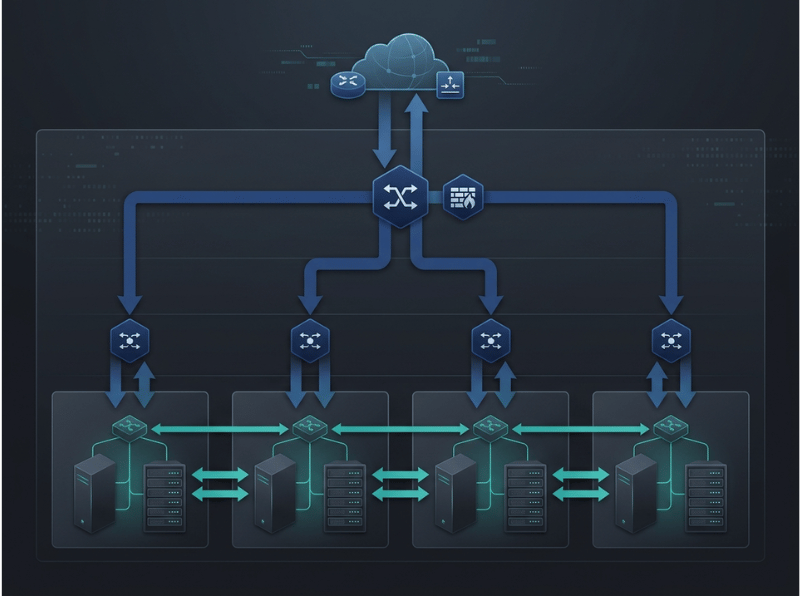
Modern data center workloads generate far more east-west traffic—data moving laterally between servers, applications, databases, and microservices within the data center itself. This internal traffic is typically trusted by default in traditional architectures. That assumption is where attackers find their leverage.
North-south traffic flows between the data center and external entities, including users, the internet, branch offices, and cloud services. Controls here focus on perimeter firewalls, DDoS mitigation, and VPN/SD-WAN security.
East-west traffic flows between workloads inside the data center network. Without explicit controls, a compromised workload can freely access adjacent systems. Controlling east-west traffic—through microsegmentation, internal firewalling, and Zero Trust policies—is now the primary focus of advanced data center security architecture.
How does Zero Trust architecture apply to data center security?
Zero Trust is a security framework built on a single principle: never trust, always verify. No user, device, or workload is granted implicit trust based on network location alone. Every access request is authenticated, authorized, and continuously validated—regardless of whether it originates outside or inside the data center.
NIST Special Publication 800-207 provides the authoritative definition of Zero Trust Architecture and outlines seven core tenets, including:
- All data sources and computing services are considered resources
- All communication is secured regardless of network location
- Access to individual resources is granted on a per-session basis
- Access is determined by dynamic policy, including behavioral and environmental attributes
In a data center context, Zero Trust architecture means that a workload in the application tier cannot automatically communicate with a database server simply because both are on the internal network. Each communication path must be explicitly permitted and continuously enforced.
What is microsegmentation and why does it matter for data center security?
Microsegmentation is the foundational enforcement mechanism for Zero Trust inside a data center. It logically divides the network into granular segments and enforces access policies at the workload, application, and even process level—rather than at the coarse VLAN or network zone level.
As HCLTech’s Senior Consultant, Lovkesh Bogra, explains: “Traditional perimeter defenses assume implicit trust once inside the network; micro-segmentation removes that assumption. It minimizes both attack surface and blast radius by logically dividing environments into smaller, isolated segments.”
The practical effect is significant. With microsegmentation in place:
- A compromised workload cannot initiate connections to other workloads unless explicitly permitted
- Ransomware cannot propagate laterally across server groups
- Web-tier workloads cannot communicate directly with database-tier workloads unless policy permits it
- Administrative traffic is isolated from application traffic
Microsegmentation supports key regulatory frameworks, including NIST SP 800-207, DORA, and ICS/OT standards such as IEC 62443. It also delivers operational benefits: by eliminating unnecessary lateral traffic, it reduces network congestion and improves application performance.
Deployment models include OS-based agents, hypervisor hooks, CNI plugins for Kubernetes, agentless gateways for legacy and OT environments, and SDN-based enforcement.
The recommended implementation path is to begin in discovery mode—mapping all east-west traffic flows without enforcement—before applying policies incrementally, starting with the highest-value or highest-risk segments.
How should threat detection and response be architected for data centers?
A modern threat detection and response (TDR) architecture for data centers integrates telemetry from multiple sources into a unified platform:
- SIEM for log aggregation, correlation, and alert generation
- Network detection and response (NDR) for visibility into east-west traffic anomalies that endpoint tools miss
- Endpoint detection and response (EDR) on servers and workloads
- Identity threat detection to surface unusual authentication patterns, privilege escalation, and lateral movement through compromised credentials
The integration of these tools—increasingly achieved through XDR platforms—reduces mean time to detect (MTTD) and mean time to respond (MTTR), the two metrics most directly correlated with breach cost reduction.
What does redundancy mean in the context of data center security?
Redundancy is both a resilience strategy and a security control. Designing data center infrastructure for no single point of failure means that an attacker who disables one component cannot take down the entire environment.
Key redundancy considerations include:
- Power: Uninterruptible power supplies (UPS), backup generators, and dual power feeds from separate utility feeds
- Cooling: Redundant cooling systems, including N+1 or 2N configurations, to prevent server failures from overheating during a primary cooling system failure
- Network connectivity: Dual ISP connections with automatic failover, and redundant internal network paths
- Environmental monitoring: Leak detection sensors (particularly critical in liquid-cooled environments), smoke detectors, and temperature sensors with automated alerting and shutdown triggers
A cooling failure that forces servers offline is functionally identical to a DDoS attack from a business continuity perspective. Environmental resilience is therefore properly understood as a security requirement.
Data Center Security Best Practices
What are the best practices for securing a data center in 2025?
The following nine-point checklist represents the core actions enterprise security teams should take to establish and maintain a defensible data center security posture:
1. Conduct a comprehensive risk assessment
Map all assets, data flows, access paths, and third-party connections. You cannot protect what you haven’t inventoried.
2. Implement Zero Trust architecture
Eliminate implicit trust based on network location. Enforce authentication and authorization for every access request, including internal workload-to-workload communication.
3. Deploy microsegmentation
Divide the data center network into granular segments with explicit east-west traffic policies. Start with discovery mode to baseline existing flows before applying enforcement.
4. Harden physical access controls
Implement multilayer physical security with biometric authentication, man-trap vestibules, RFID-based asset tracking, and 24/7 CCTV monitoring. Restrict physical access to the minimum number of personnel necessary.
5. Enforce least-privilege access with PAM
Audit all privileged accounts, service accounts, and third-party access. Implement PAM tools to manage, monitor, and record privileged sessions. Revoke standing access in favor of just-in-time provisioning.
6. Encrypt data at rest and in transit
Ensure all sensitive data is encrypted using current standards, with encryption keys managed in a dedicated KMS, separate from the data they protect.
7. Maintain immutable, tested backups
Implement an offline or write-once backup strategy that ransomware cannot reach. Test restores regularly—an untested backup is not a backup.
8. Implement continuous monitoring and logging
Deploy SIEM or XDR capabilities that provide real-time visibility across physical, network, and workload layers. Maintain tamper-proof logs that meet relevant compliance retention requirements.
9. Test and rehearse incident response
Run tabletop exercises against realistic scenarios at least annually. Maintain documented, current playbooks for ransomware, insider threat, physical breach, and environmental incidents.
How to Secure Hybrid and Cloud-Connected Data Centers
What are the unique security challenges of hybrid data centers?
Hybrid data centers—environments that combine on-premises infrastructure with one or more cloud platforms—are now the dominant architecture for enterprise organizations. The security challenges they introduce are meaningfully different from either pure on-premises or pure cloud environments.
The core problem is policy fragmentation. Identity controls that work well on-premises may not extend consistently to cloud workloads. Network security policies enforced at the data center perimeter don’t automatically apply to cloud-hosted services. Logging formats differ between platforms, creating blind spots in SIEM correlation.
Key security requirements for hybrid data center environments include:
- Unified identity management: A single identity provider (IdP) and consistent MFA enforcement across on-premises and cloud environments, avoiding the creation of parallel identity stores
- Consistent network segmentation: Microsegmentation policies that apply equivalently to on-premises workloads and cloud workloads, regardless of where they run
- Secure connectivity: Dedicated private connectivity (such as AWS Direct Connect, Azure ExpressRoute, or equivalent) between on-premises data centers and cloud environments, rather than routing sensitive traffic over the public internet
- Shared responsibility clarity: Cloud providers operate under a shared responsibility model—they secure the infrastructure; customers secure their data, configurations, and access controls. Misunderstanding this boundary is a primary cause of cloud-related data breaches
- Cloud security posture management (CSPM): Automated tools that continuously scan cloud configurations for security misalignments, exposed storage buckets, over-permissive IAM policies, and compliance deviations
- Consistent logging and visibility: A centralized SIEM or XDR platform that ingests telemetry from both on-premises and cloud environments, enabling unified detection and response
The practical guideline for hybrid security is this: if a security control cannot be applied consistently across both environments, it will be bypassed—accidentally or deliberately—at the boundary.
How to Evaluate Data Center Security Solutions
What criteria should enterprises use when selecting data center security tools?
The data center security vendor landscape is broad, covering physical security systems, network security platforms, PAM tools, SIEM and XDR solutions, microsegmentation platforms, and backup/recovery systems. Evaluating them effectively requires a structured framework.
|
Evaluation Criterion |
Why It Matters |
|---|---|
|
Coverage breadth |
Can the solution cover on-premises, cloud, and hybrid environments with consistent policy enforcement? |
|
Integration capability |
Does it integrate with existing identity providers, SIEM platforms, CMDB systems, and IT service management tools? |
|
Scalability |
Can it handle the volume of east-west traffic and workload density in your environment without introducing latency? |
|
Operational complexity |
What is the implementation and management overhead? Solutions that require specialized expertise for daily operation create operational risk |
|
Compliance support |
Does the solution generate audit-ready evidence for relevant frameworks (PCI DSS, HIPAA, SOC 2, ISO 27001)? |
|
Vendor track record |
What is the vendor’s response history for critical vulnerabilities in their own products? |
|
Total cost of ownership |
Licensing, implementation, integration, training, and ongoing management costs over a three-to-five-year horizon |
One often-overlooked criterion is fail behavior: when a security tool fails, does it fail open (traffic permitted) or fail closed (traffic blocked)? For high-security environments, fail-closed behavior is strongly preferred, even at the cost of some availability.
Before committing to a platform, run a proof of concept in a non-production environment. Measure detection accuracy, false positive rate, performance impact on workloads, and integration quality with your existing tooling.
Data Center Security FAQs
What is data center security?
Data center security is the combination of physical controls, network architecture, workload hardening, identity management, data protection practices, and monitoring systems used to protect data center infrastructure from unauthorized access, data breaches, service disruption, and compliance violations. Effective data center security treats protection as a layered stack—physical, network, workload, and data—rather than relying on any single control.
Why is data center security important for enterprises?
Data centers concentrate an organization’s most valuable digital assets. A successful breach or extended outage can cost millions in direct losses, regulatory fines, and reputational damage. According to the IBM Cost of a Data Breach Report 2025, the global average breach cost is $4.44 million, with U.S. breaches averaging $10.22 million. Enterprises that invest in layered data center security significantly reduce both the probability and the cost of security incidents.
What is the difference between north-south and east-west traffic in data center security?
North-south traffic flows between the data center and external networks—users, the internet, and cloud services. East-west traffic flows laterally between workloads inside the data center. Traditional perimeter security focused on north-south controls. Modern data center security requires equal rigor over east-west traffic, because most successful attacks involve lateral movement between internal workloads after an initial compromise.
What is microsegmentation, and how does it work in a data center?
Microsegmentation logically divides a data center network into granular segments and enforces access policies at the workload, application, or process level. Unlike traditional network segmentation (which operates at VLAN or network zone boundaries), microsegmentation applies fine-grained policy to individual workloads. This limits lateral movement: a compromised workload cannot freely communicate with adjacent systems unless an explicit policy permits it. Deployment options include OS-based agents, hypervisor hooks, CNI plugins for containerized environments, and agentless gateways for legacy infrastructure.
How does Zero Trust apply to data center security?
Zero Trust in a data center context means that no workload, user, or device is automatically trusted based on its network location. Every access request—including internal east-west communication between servers—is authenticated, authorized, and continuously validated against dynamic policy. NIST SP 800-207 provides the authoritative Zero Trust Architecture framework. In practice, implementing Zero Trust in a data center starts with mapping all traffic flows, then applying microsegmentation policies that enforce least-privilege communication between workloads.
What compliance frameworks apply to data center security?
The relevant compliance framework depends on the industry and data types involved:
- PCI DSS: Required for environments that process, store, or transmit payment card data
- HIPAA: Applies to U.S. healthcare organizations handling protected health information (PHI)
- SOC 2 (Type II): Widely required by enterprise customers as evidence of operational security controls
- ISO 27001: International standard for information security management systems, applicable across industries
- NIST CSF: A voluntary framework widely adopted by U.S. organizations as a security management baseline
- DORA: The EU Digital Operational Resilience Act, applicable to financial sector organizations
Microsegmentation and access controls are explicitly referenced in several of these frameworks. Compliance should be a floor, not a ceiling—regulatory requirements represent minimum controls, not optimal security posture.
How does security responsibility differ between on-premises and cloud data centers?
On-premises data centers place full security responsibility with the organization—physical infrastructure, network, operating systems, applications, and data. Cloud environments operate under a shared responsibility model: the cloud provider secures the underlying infrastructure (physical hardware, hypervisor, and network fabric), while the customer is responsible for operating system configuration, application security, data protection, and identity management. The shared responsibility boundary varies by service model (IaaS, PaaS, SaaS). Misunderstanding this boundary—assuming the cloud provider handles more than they do—is a frequent cause of cloud data exposures.
Is data center cooling a security issue?
Yes. Cooling failures are one of the most common causes of unplanned data center downtime, and unplanned downtime is functionally equivalent to a denial-of-service attack from a business continuity perspective. Environmental monitoring systems—including temperature sensors, humidity monitors, and leak detection for liquid-cooled environments—are security controls in the same sense that firewalls are. A cooling system failure that takes servers offline has the same operational impact as a volumetric DDoS attack.
What happens to data center security during a power outage?
A well-designed data center maintains security controls through a power outage via layered redundancy: uninterruptible power supplies (UPS) provide immediate short-term power, generator systems provide longer-term backup power, and dual utility feeds reduce the risk of simultaneous loss of both primary and backup power. From a security perspective, power failure scenarios should be tested regularly—access control systems, CCTV, and network security tools must all maintain function during power events. Fail-closed configurations for security tools are essential: a power event should not become an opportunity for physical or logical access.
What are the biggest data center security mistakes enterprises make?
The most common mistakes include:
- Treating perimeter security as sufficient: Failing to control east-west traffic inside the network
- Neglecting physical security: Underinvesting in physical controls relative to digital ones
- Over-privileged accounts: Granting broad access for convenience rather than enforcing least privilege
- Untested backups: Maintaining backup infrastructure without regularly verifying restoration capability
- Inconsistent hybrid security: Applying strong controls on-premises while leaving cloud workloads under-secured
- Delayed patching: Leaving known vulnerabilities unpatched due to operational constraints
Data Center Security Starts with the Right Architecture
The organizations most effectively protected against data center threats share one characteristic: they stopped treating security as a single perimeter problem and started treating it as a layered, continuously validated discipline.
The threats are real, the costs are documented, and the architectural tools to address them—Zero Trust, microsegmentation, immutable backups, least-privilege access, and continuous monitoring—are mature and deployable today.
The gap isn’t knowledge. Its execution.
The starting point for most enterprises is an honest inventory: what workloads are running where, what traffic flows between them, who has access to what, and where the monitoring gaps are. From that baseline, a prioritized security roadmap becomes achievable.
