


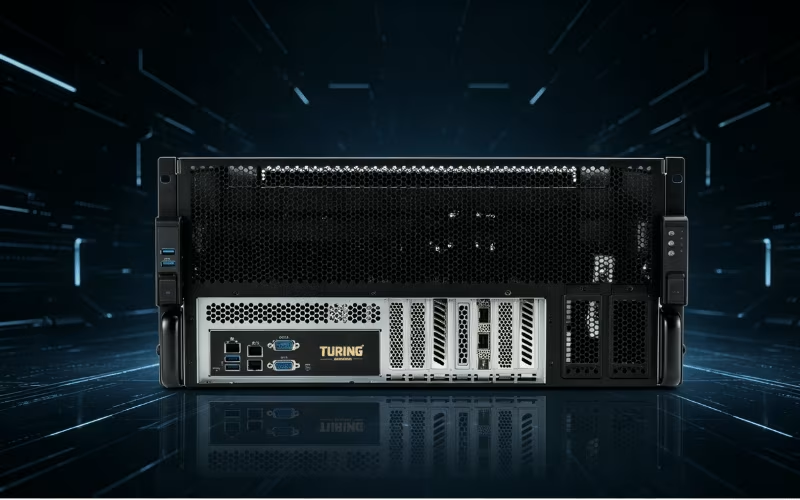
Managing the extreme heat generated by high-performance computing hardware requires highly specialized infrastructure. As industries increasingly rely on massive computational power for complex tasks such as artificial intelligence training, deep learning, and advanced 3D rendering, standard cooling methods often fall short. This growing demand has pushed liquid-cooled GPU server cases to the forefront of modern data center design. These advanced enclosures use thermally conductive fluids to absorb and dissipate heat from critical components, offering a compelling alternative to traditional fan-based air cooling.
While air cooling has served as the reliable standard for decades, the sheer thermal output of modern enterprise graphics processing units makes liquid cooling an incredibly attractive option. However, adopting this technology is not a simple decision. It offers a unique set of benefits, such as vastly superior heat dissipation and whisper-quiet operation, but also introduces significant challenges, including higher upfront costs and complex maintenance requirements.
In this comprehensive guide, we will explore the precise advantages and disadvantages of liquid-cooled GPU server cases. By understanding the pros and cons and how this technology compares directly with traditional air cooling, you can make a well-informed decision for your next high-performance server build.
What Are the Advantages of Liquid-Cooled GPU Server Cases?
Superior Cooling Performance
The most significant advantage of utilizing a liquid-cooled GPU server case is its absolutely superior cooling performance. Liquid inherently possesses a much higher thermal conductivity and specific heat capacity than air. This means that a liquid cooling loop can absorb, transport, and dissipate massive amounts of thermal energy far more efficiently than even the most powerful high-RPM server fans. When you run high-performance GPUs under maximum load for continuous artificial intelligence training or complex mathematical simulations, they generate extreme heat. Liquid cooling systems feature custom cold plates that mount directly onto the GPU silicon, immediately drawing that heat away from the processor. This rapid heat transfer ensures that your graphics cards operate well within their safe thermal limits, even during the most demanding and intensive enterprise workloads. Consequently, your hardware maintains peak processing speeds without any risk of thermal throttling.
Reduced Noise Levels
Another massive benefit of liquid-cooled GPU server cases is the drastic reduction in operational noise. Traditional air-cooled servers rely on arrays of small, incredibly fast-spinning fans to force massive volumes of air through the chassis. These high-speed fans often sound like jet engines, creating a disruptive and unpleasant acoustic environment. Liquid cooling systems completely change this dynamic. By using a quiet mechanical pump to circulate the fluid and large, slow-spinning fans on an external radiator to dissipate heat, liquid cooling significantly lowers the server’s overall acoustic output. This makes liquid-cooled cases absolutely ideal for environments where noise reduction is highly critical, such as open-plan creative studios, academic research laboratories, or small office spaces that cannot isolate their servers in a dedicated, soundproofed data center room.
Improved Thermal Stability
Maintaining a consistent operating temperature is absolutely vital for the longevity and reliability of expensive enterprise hardware. Liquid-cooled GPU server cases excel at providing improved thermal stability across the entire system. Because liquid absorbs heat so effectively, it prevents the sudden, massive temperature spikes that often occur when a GPU suddenly tackles a heavy computational load. This consistent thermal baseline prevents thermal throttling, a protective measure in which the GPU artificially slows itself to prevent heat damage. By eliminating thermal throttling, liquid cooling ensures your GPUs deliver optimal, sustained processing performance around the clock. Furthermore, this stable thermal environment drastically reduces the physical stress caused by constant heating and cooling cycles, extending the overall lifespan of the graphics cards and the surrounding motherboard components.
Space Efficiency
High-performance air cooling requires massive metal heatsinks and thick fan shrouds, which take up a tremendous amount of physical space inside the chassis. Liquid cooling systems offer exceptional space efficiency. The water blocks that attach directly to the GPUs are incredibly thin and compact compared to traditional air coolers. This slim profile frees up a massive amount of valuable real estate inside the server case. With the bulky heatsinks removed, system builders can organize internal components much more effectively. The extra space allows for highly efficient cable routing, leaving unobstructed pathways that further improve the ambient internal temperatures. This compact internal design makes it incredibly easy to access components during routine maintenance or hardware upgrades.
Aesthetic Appeal
While performance remains the primary concern for enterprise servers, the aesthetic appeal of a liquid-cooled system cannot be completely ignored. Liquid-cooled GPU server cases often feature visually stunning internal designs. The precise routing of clear acrylic tubing, the sleek metallic finishes of the custom water blocks, and the carefully arranged coolant reservoirs create an incredibly clean and professional appearance. Many modern liquid cooling components also include highly customizable RGB lighting systems. While RGB might seem unnecessary for a hidden data center rack, it offers a significant visual benefit for high-end creative workstations or for showcase servers in highly visible studio environments. Administrators can even program these lighting systems to visually indicate the coolant’s current temperature, turning aesthetics into a functional monitoring tool.
Scalability for Multi-GPU Setups
Modern machine learning and deep learning applications require massive parallel processing power, often necessitating the use of 4, 8, or even more GPUs on a single server node. Liquid cooling offers incredible scalability for these dense multi-GPU setups. When you stack multiple air-cooled graphics cards right next to each other, the fans struggle to pull in fresh air, leading to immediate overheating. Because liquid cooling water blocks are so thin, you can safely pack multiple GPUs closely together without suffocating them. The liquid loop efficiently transports heat away from each card in the chain, routing it to a massive external radiator. This scalability allows data centers to maximize their computational density, fitting vastly more processing power into a single server rack than traditional air cooling would ever permit.
Energy Efficiency
Although it seems counterintuitive, deploying a liquid-cooled GPU server case can actually improve your facility’s overall energy efficiency. Traditional air-cooled servers rely on numerous high-speed fans that run continuously at maximum RPM to keep the hardware safe. These industrial fans consume a surprisingly large amount of electricity. A liquid cooling system utilizes a highly efficient mechanical pump and a few large, slow-spinning radiator fans. This specific configuration drastically reduces the mechanical energy required to cool the system. By reducing the overall power consumption for thermal management, organizations can significantly lower their monthly electricity bills. Over the operational lifespan of a massive data center, the energy efficiency of liquid cooling translates into substantial financial savings and a significantly reduced carbon footprint.
What Are the Disadvantages of Liquid-Cooled GPU Server Cases?
High Initial Cost
The most immediate barrier to adopting a liquid-cooled GPU server case is the exceptionally high initial cost. Liquid cooling systems are vastly more expensive than traditional air cooling setups. When you purchase an air-cooled server, the heatsinks and fans come pre-installed on the hardware. Building a liquid-cooled system requires purchasing numerous expensive, specialized components. You must buy high-performance mechanical pumps, massive copper radiators, custom GPU water blocks, specialized compression fittings, and the thermally conductive coolant itself. Furthermore, server cases designed specifically to house these intricate liquid-cooling loops often carry a premium price tag. For small businesses or research teams operating on a strict IT budget, this massive upfront financial investment can make liquid cooling incredibly difficult to justify, despite the obvious performance benefits.
Complex Installation and Maintenance
Unlike traditional air coolers that simply snap onto a motherboard, liquid cooling systems demand a highly complex installation process. Building a custom liquid loop requires carefully measuring and cutting tubing, securely tightening dozens of fittings, and meticulously filling the system with coolant while actively bleeding out trapped air bubbles. This intricate process requires significant technical expertise and patience. If a technician makes a single mistake during installation, the results can be catastrophic. Furthermore, liquid cooling requires strict, ongoing maintenance. Administrators must regularly flush the system, thoroughly clean the water blocks to prevent organic growth or mineral buildup, and replace the specialized coolant annually. This high level of required maintenance demands dedicated IT hours that many fast-paced organizations simply cannot spare.
Potential for Leaks
The most terrifying risk associated with liquid-cooled GPU server cases is the potential for leaks. You are intentionally introducing a conductive liquid into a closed environment packed with highly sensitive, incredibly expensive electronic components. Even a tiny, slow drip from a loose compression fitting can cause a massive electrical short, instantly destroying thousands of dollars’ worth of enterprise GPUs and motherboards. While modern liquid-cooling hardware is incredibly reliable, the physical risk of a leak is never zero. Vibrations from hard drives, degrading rubber O-rings, or accidental bumps during routine maintenance can compromise the watertight seal. This inherent danger emphasizes the absolute importance of purchasing premium, high-quality components and conducting frequent, rigorous visual inspections of the entire cooling loop.
Limited Compatibility
Upgrading to a liquid-cooled setup requires careful planning because not all server cases are designed to support these complex systems. Liquid cooling loops require massive physical space for large copper radiators, tall cylindrical fluid reservoirs, and thick routing tubes. Standard server chassis often lack the necessary mounting brackets or internal clearance to accommodate these bulky components. You must carefully evaluate the exact dimensions of your chosen server case, ensuring it offers dedicated radiator mounting points and enough depth to clear the liquid pumps. This limited compatibility severely restricts your hardware choices, forcing you to purchase specialized, often more expensive enclosures engineered for advanced liquid cooling compatibility.
Higher Power Consumption
While liquid cooling can reduce the power draw of high-speed case fans, the specialized components within the loop introduce their own power demands. The heavy-duty mechanical pumps required to push thick coolant through restrictive water blocks and massive radiators consume a notable amount of electricity. In incredibly dense server setups that require dual redundant pumps to ensure liquid flow, this power draw becomes even more significant. Additionally, the large radiator fans, while spinning slower than traditional server fans, still require consistent power. When calculating the total power envelope of your server rack, you must carefully account for the electrical overhead introduced by advanced liquid-cooling hardware, ensuring your power supplies can handle the sustained load.
Noise from Pumps
A major selling point of liquid cooling is its quiet operation, but it is entirely a myth that these systems are completely silent. While you eliminate the deafening roar of high-RPM server fans, you introduce new acoustic elements into the environment. The mechanical pumps that circulate the coolant operate continuously and can produce a highly noticeable low-frequency hum or buzz. In cheaper or poorly isolated pumps, this vibration can transfer into the metal server chassis, amplifying the sound significantly. Furthermore, if air bubbles become trapped inside the closed loop, the system will produce loud, distracting gurgling or splashing noises. While liquid cooling is generally much quieter than air cooling, the specific noise produced by liquid pumps can still be bothersome in ultra-quiet working environments.
Shorter Lifespan of Components
Traditional air cooling heatsinks are essentially solid blocks of metal that never degrade; only the attached plastic fans eventually fail. In stark contrast, liquid cooling systems feature multiple components with relatively short operational lifespans. The mechanical pumps work tirelessly under high pressure and will inevitably wear out and fail, requiring expensive replacements. The rubber O-rings inside the compression fittings slowly degrade over time due to constant temperature fluctuations, increasing the risk of severe leaks. Furthermore, the specialized coolant fluid breaks down, loses its anti-corrosive properties, and must be completely drained and replaced every twelve to twenty-four months. This constant cycle of component degradation and replacement adds significantly to the server’s long-term maintenance costs.
Liquid Cooling vs. Air Cooling: Which Is Better for GPU Server Cases?
Cooling Efficiency
When comparing raw cooling efficiency, liquid cooling vastly outperforms traditional air cooling. Liquid possesses a massive capacity to absorb and transport heat away from hot silicon. For high-performance GPUs running maximum-intensity workloads such as machine learning or real-time rendering, liquid cooling ensures the hardware does not succumb to thermal throttling. It rapidly pulls heat directly from the GPU die and transfers it to an external radiator. However, air cooling remains entirely sufficient for less demanding workloads. If your servers primarily handle basic web hosting, file storage, or lightweight application processing, the extreme cooling capacity of a liquid loop is largely unnecessary. High-quality air coolers can easily maintain safe temperatures for standard enterprise tasks without the added complexity of fluid dynamics.
Cost Comparison
Cost is often the deciding factor when choosing a thermal management system. Air-cooling systems are incredibly affordable and easy to install. The heatsinks and fans are usually included directly with the hardware or cost a small fraction of the total system price. Liquid cooling systems, on the other hand, require a massive upfront financial investment. Purchasing custom water blocks, industrial pumps, radiators, and specialized server cases adds thousands of dollars to the build cost. However, for organizations that require absolute maximum performance, the liquid cooling investment pays off over time. By preventing thermal throttling, extending the lifespan of expensive GPUs, and slightly reducing overall energy costs, liquid cooling offers highly tangible long-term financial benefits that can offset the initial sticker shock.
Maintenance Requirements
Maintenance requirements differ wildly between the two technologies. Air cooling systems are remarkably hands-off. Aside from occasionally using compressed air to blow accumulated dust off the metal heatsinks and replacing a dead fan every few years, they require virtually no ongoing maintenance. This makes air cooling perfect for remote data centers or small teams lacking dedicated IT staff. Liquid cooling systems demand rigorous, scheduled maintenance. System administrators must perform regular visual inspections for micro-leaks, monitor reservoir fluid levels, and perform a complete system flush and coolant replacement annually. If your organization lacks the time or technical expertise to perform this constant upkeep, a liquid-cooled server case will quickly become a massive operational liability.
Noise Levels
Acoustic output is a major consideration depending on where your server case will be physically located. Air cooling systems, especially in dense 1U or 2U rack-mount servers, are incredibly noisy. They use small fans that spin at extremely high velocities to force air through the chassis, creating a loud, high-pitched whine that makes working nearby impossible. Liquid cooling systems drastically reduce this acoustic nightmare. By using a quiet mechanical pump and large, slow-spinning radiator fans, they operate at a fraction of the decibel level. If your GPU server case sits in a recording studio, a video editing bay, or an open-plan office space where noise reduction is absolutely critical, liquid cooling is undoubtedly the superior, quietest choice.
Scalability
Scalability becomes a massive issue when you attempt to pack multiple high-end GPUs into a single server chassis. Air cooling struggles immensely in high-density setups. When you stack three or four thick, air-cooled graphics cards next to each other, they block each other’s airflow. The cards choke on hot exhaust air, leading to immediate overheating and severe performance drops. Liquid cooling is inherently better suited for dense multi-GPU server configurations. Because liquid water blocks are incredibly thin, you can safely pack numerous GPUs side-by-side without restricting their cooling capacity. The liquid loop efficiently pulls heat from every single card simultaneously, making it the only viable choice for massive, high-density artificial intelligence and deep learning server nodes.
Risk Factors
Risk tolerance plays a critical role in data center management. Air cooling is the safest, most reliable thermal management method available. The absolute worst-case scenario is a fan failing, which causes the server to shut down safely to prevent heat damage. You replace the cheap fan, and the server runs perfectly again. Liquid cooling introduces a terrifying risk factor: catastrophic leaks. Pumping electrically conductive fluid directly over thousands of dollars’ worth of sensitive silicon creates a very real risk of total hardware destruction. While high-quality compression fittings and rigorous leak-testing minimize this risk, it never disappears completely. Organizations running mission-critical databases must carefully weigh the performance benefits of liquid cooling against the nightmare scenario of a destroyed server.
Conclusion
Choosing the right thermal management system for your high-performance hardware is a critical decision that impacts your entire operational workflow. As we have explored, liquid-cooled GPU server cases offer spectacular advantages, including vastly superior cooling performance, significantly reduced acoustic noise, and the incredible scalability required for dense multi-GPU setups. However, these massive benefits are closely trailed by severe disadvantages. The exceptionally high initial costs, complex ongoing maintenance requirements, and the ever-present danger of catastrophic leaks make liquid cooling a serious commitment that requires technical expertise and careful planning.
Ultimately, deciding whether to invest in a liquid-cooled setup depends entirely on your specific operational constraints. You must carefully evaluate your strict IT budget, your absolute performance needs, and your team’s capability to perform routine maintenance. If you run intensive artificial intelligence workloads in a noise-sensitive environment, the investment in liquid cooling is easily justified. As computing demands continue to skyrocket, the thermal limits of traditional air cooling will inevitably be reached. The future of high-performance GPU server cases undoubtedly leans heavily toward advanced liquid-cooling technologies, promising even safer, more efficient, and more accessible solutions for tomorrow’s data centers.
Learn More about the Product:
