


Standard server cases were built for CPUs, spinning disks, and moderate power draw. AI workloads changed all of that. If you’re training models or running inference at scale, the chassis you pick either keeps your GPUs running full-tilt or quietly holds them back. Here are five reasons a purpose-built GPU Server Case wins every time.
Cooler GPUs, no throttling. AI training pushes GPUs to near-full utilization for hours or days on end. A standard case relies on airflow tuned for light CPU loads, so it can’t keep up, and your GPUs slow themselves down to avoid overheating. That throttling stretches training time and inflates your compute bill. GPU server cases fix this with high-airflow layouts, or a Liquid-Cooled GPU Server Case when your hardware runs flat-out around the clock.
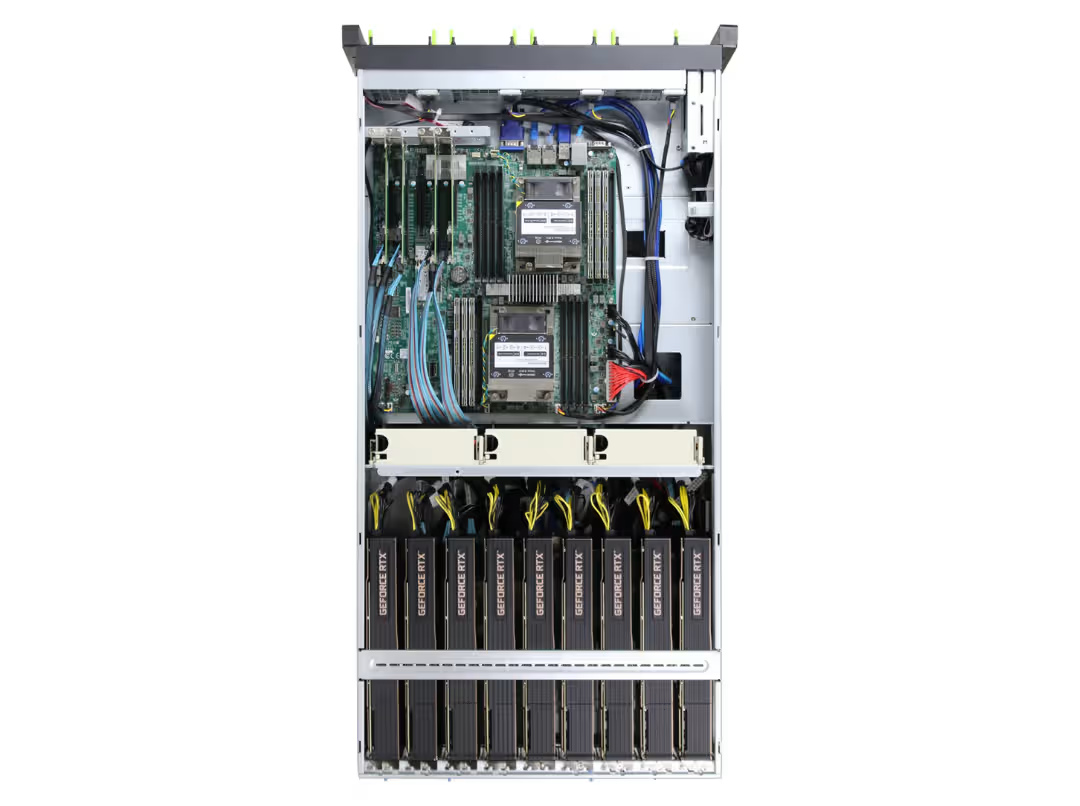
More GPUs per chassis. Standard cases give you one or two expansion slots. That’s fine for general compute, but AI runs on parallel GPUs. GPU server cases are built the opposite way, with reinforced PCIe support and heights from 4U to 10U. An 8U GPU Server Case (OCG5800-8H4-L) packs 8 GPUs into a single chassis, so your infrastructure stays tight instead of sprawling across racks.
Power that actually holds up. AI-grade GPUs draw serious wattage, and that draw multiplies fast across four, eight, or more cards. Standard cases lean on single or dual PSUs sized for storage builds. Push GPU loads through that, and you’re either running outside safe margins or starving your cards. GPU server cases ship with high-wattage, multi-rail power supplies made for exactly this load. It’s the difference between a chassis that sustains peak draw and one that can’t.
Steady performance under long jobs. AI training runs in long, parallel cycles where every GPU works at once, often for the full length of a job. Thermal design and power delivery work together to keep performance steady from start to finish, rather than degrading as things heat up. Faster job completion means a lower effective compute cost. For teams where completion time drives spend, that alone pays for the upgrade.
Room to grow. AI infrastructure never sits still. You add GPUs, upgrade generations, and scale clusters as demand climbs. A standard case hits its ceiling fast and forces a full replacement. GPU server cases leave headroom for that growth, so you skip the costly mid-project retrofit. Plan for a bigger cluster? Start with a chassis built to expand.
The gap isn’t preference; it’s engineering. A standard case that falls short on cooling, density, or power can bottleneck your entire AI deployment. Browse the full GPU Server Case range to match your GPU count and cooling needs, or contact our team for OEM/ODM customization. Leave the standard case in the closet.
