


Rack Mount Cases are known as RMC. RMC is a standardized enclosure technology that combines structural integrity with system organization. It refers to the operational framework for housing and protecting critical computer hardware within a standard 19-inch rack.
What is a Rack Mount Case?
A rack-mount case uses a standardized enclosure system composed of a chassis and mounting ears to provide continuous housing. Leveraging the standardized 19-inch width to organize high-density hardware, each vertical unit (U) of the rack space is managed independently for hardware installation, cable management, and airflow.
Various computer components, such as motherboards, power supplies, storage drives, and expansion cards, are fitted into the case through the front, top, or rear access points. The case is then installed into the rack cabinet to complete a series of basic operational functions such as data processing, networking, storage, and industrial control, while providing secure mounting, organized cabling, and efficient cooling.
The traditional standalone or tower case generally uses custom dimensions, houses components with less focus on spatial efficiency. It is then placed on a desk or floor to perform its function. The tower case primarily provides physical protection in a stable environment, with the system transitioning from an off state to an on state under controlled conditions. There are significant operational demands in industrial or data center settings, such as high-density deployment, thermal management, and serviceability, which tower cases cannot efficiently address.
The complexity of managing multiple high-powered systems tends to increase significantly in scaled operations or demanding industrial environments. Practice has shown that when multiple systems are needed, standalone cases become unwieldy and inefficient and need to be consolidated into a more organized solution. Rack-mount cases can achieve high-density deployment in this scenario. The standardized enclosure system, composed of a chassis and mounting ears, can reduce the equipment’s physical footprint and use the rack structure to manage airflow and cabling, thereby integrating the needs of multiple systems with the physical space into a complete, continuous process.
The properties of the components themselves determine the essential laws of electronics and thermodynamics and do not change due to the rack-mount system. However, the rack system affects operational results because it changes the conditions of the equipment’s “micro-environment”. For rack-mount cases, space efficiency, thermal management, and serviceability play a key role in operational results, and they are interconnected and influence one another.
Key Features of Rack Mount Cases
- Durable Construction for Harsh Environments
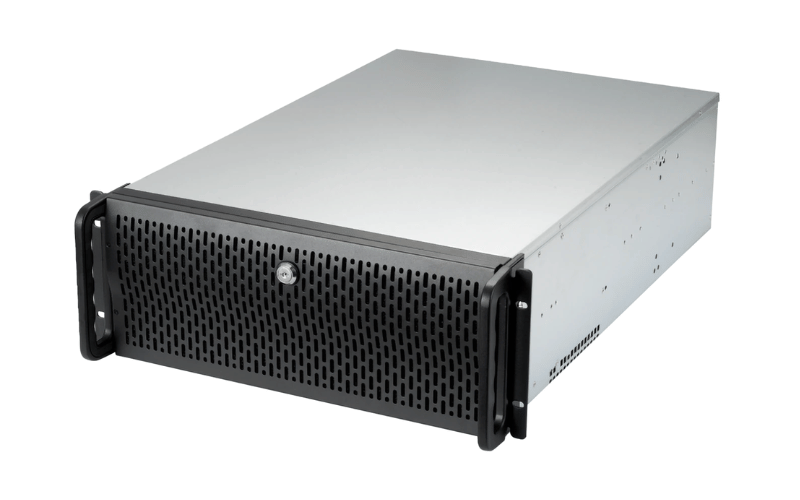
The case must provide enough structural rigidity to support heavy internal hardware and resist deformation. Additionally, there must be adequate protection in the front and rear panels to shield components from impact, which requires a heavy-duty steel construction, often using cold-rolled steel. - Security Features
Physical access to the system interfaces should be restricted to ensure that critical data and controls are fully protected. At the same time, it is crucial to prevent unauthorized access to drives or ports or tampering with them due to exposed front panels. - Cable Management Performance
During rack installation, not all connecting cables will naturally lie flat or out of the way. Therefore, it is necessary to manage internal and external wiring to prevent airflow blockages and accidental disconnections. This typically requires organizing routing paths within the chassis without causing cooling efficiency to drop. - Flexible Mounting Options
The chassis must have strong rail compatibility and mounting adaptability. Since the depth of rack cabinets can vary widely across manufacturers, making installation and stabilization difficult, the case’s mounting options need to be enhanced. Strong slide rails can also facilitate easy servicing. - Efficient Cooling Mechanisms
During continuous operation, especially in high-density rack deployments, the significant heat generated must be quickly removed from the enclosure. Therefore, the rack-mount case should have excellent cooling capabilities, typically achieved with high-CFM fans and optimized airflow zones.
Types of Rack Mount Cases
The cases used for rack-based computing include standard-height cases (1U, 2U, 4U), specialized GPU server cases, and high-density dual-node server cases. A comparison of the three primary types is as follows:
|
Standard Height Cases (1U, 2U, 4U) |
Dual-Node Server Cases |
||
|---|---|---|---|
|
Advantages |
High efficiency, precise layout, multi-function, easy operation, good expandability, low energy consumption, and environmental protection. It offers standardized sizing, uniform airflow, strong component support, and good service access. |
Simple design, higher cost, good thermal performance, high power delivery, quiet operation, stable performance, large cooling capacity, and extended component life. |
It has the characteristics of extreme density, high efficiency, high compute power, and shared infrastructure, combining the advantages of two independent servers in a single chassis. |
|
Disadvantages |
The structure is simple, the price is low, and thermal management in high-power configurations is challenging to analyze accurately. |
Component placement relies mainly on specialized layouts, and general-purpose expandability is limited. Standard CPUs, low-profile cards, and fewer storage drives are difficult to justify in this specialized chassis. When GPU heat is high, airflow demands increase and power consumption rises. |
Although it combines the advantages of two servers, its complexity may reduce the ease of servicing individual nodes and increase thermal density, requiring more robust rack-level cooling. |
|
Scope of Application |
Suitable for applications that require general-purpose computing and high expandability. |
Suitable for applications that do not require high component flexibility. |
There are high requirements for compute density and operational efficiency. |
The most popular and practical option today for general industrial and server applications is the standard 1U, 2U, or 4U case.
Cases designed for specific applications are distinct from general-purpose cases used for desktop PCs. Industrial deployments typically use 1U, 2U, or 4U rack mount cases. Because they have the following characteristics:
- Highly efficient use of rack space to improve density.
- Highly efficient and standardized cooling pathways.
- Highly efficient serviceability to reduce downtime.
- Reasonable component compatibility and expansion options.
Industrial computing can use non-standard case sizes, but it is less common than using standardized form factors.
Application of GPU and Dual-Node Cases in Industrial Computing
They are often used in applications that require high-performance computing and better control of server density and thermal output.
Compared with standard cases, specialized GPU and dual-node cases provide higher computational density. This is advantageous in industrial processes where high compute power may be required for AI, machine learning, or complex simulations, but rack space is limited. Although standard cases provide adequate component housing, they are generally less effective than specialized cases in managing extreme thermal loads or maximizing the number of servers per rack. This means they may not be well-suited for applications that require the highest levels of performance or efficiency.
The design of these specialized cases allows for better control of high-density deployments, which is essential for applications that require precise resource allocation and management to avoid performance bottlenecks or infrastructure overload.
While industrial computing can utilize standard rack-mount cases, it is less common for high-density or specialized GPU workloads due to their lower density and less-optimized thermal and power designs. Specialized cases are often favored for their efficient compute density, better environmental control, and versatility, making them more suitable for a broader range of high-performance industrial applications. However, for specific processes that require general-purpose computing with high expandability, standard cases remain a viable option. Exactly which case is the best rack mount solution depends on your particular needs.
Applications of Rack Mount Cases
Rack mount cases have been widely used in data centers, server rooms, industrial automation, and high-performance computing, and have played an essential role in hardware organization, thermal management, and large-scale system deployment.
The types of solutions that rack mount cases can implement are as follows:
- Housing servers directly for the centralized processing of data
- Configuring gateways or controllers first, and then adding them to the rack to control processes
- Creating functional systems by adding accelerators to the case and computationally enabling them
- Creating computing clusters by integrating the node with the backplane in the chassis
- Creating specific solutions by controlled integration of hardware in the enclosure
How to Choose the Right Rack Mount Case
Selection criteria for rack mount cases:
- Environmental Conditions
The chassis must provide enough protection for the hardware to operate reliably. Additionally, the intake section must have adequate shielding to filter particulates from the environment, which requires a robust case with appropriate ingress protection. - Application Requirements
The internal configuration of the chassis should be spacious to ensure that the performance goals are fully met. At the same time, it is crucial to prevent the storage drives, expansion cards, or processors from overheating or suffering mechanical interference due to cramped internal spacing. - Size and Form Factor
During system integration, not all standard components will fit in every form factor. Therefore, it is necessary to verify the rack unit height, mounting depth, and motherboard compatibility of the case. This typically requires achieving the right balance of density within the cabinet without obstructing airflow or cabling. - Cooling Solutions and Power Supply
The case must have strong cooling and power distribution capabilities. Since the thermal output of high-performance hardware can vary widely under load, making heat dissipation challenging, the cooling system’s airflow capacity needs to be increased. Strong power supply support can also facilitate system stability. - Vendor Reputation and Budget
During chassis selection, especially for large-scale deployments, the long-term reliability must be carefully weighed against the initial capital expenditure. Therefore, the chosen vendor should have excellent support capabilities.
Latest Trends in Rack Mount Cases
They are often used in applications that require high-density computing and tighter thermal control.
Compared with traditional air-cooled cases, liquid-cooled rack mount cases provide lower operating temperatures. This is advantageous in high-performance computing, where extreme heat may cause premature component failure or degrade sensitive processors. Although standard air cooling provides effective thermal management for most applications, it is generally less effective than direct liquid cooling for managing heat from high-wattage GPUs and CPUs. This means air cooling may not be well-suited for applications that require maximum performance without thermal throttling.
The design of modern rack-mount cases enables better scalability control, which is essential for applications that require precise timing for hardware upgrades to avoid service interruptions or costly migrations.
While rack-mount systems can utilize fixed, monolithic designs, this is less common due to their lower flexibility and poorer upgradeability. Modular designs are often favored for their efficient scalability, improved serviceability, and versatility, making them better suited to a broader range of evolving industrial applications. However, for specific processes that require a static, cost-optimized configuration, traditional fixed chassis remain a viable option. Exactly which rack-mount case is best depends on your particular needs for future growth and flexibility.
Summary
While professional environments can use standalone tower chassis, it is less common due to their lower deployment density and poorer thermal management. Rack mount cases are often favored for their structural modularity, improved cooling, and serviceability, making them more suitable for a broader range of high-performance computing applications. However, for specific processes that require isolated operation without a dedicated cabinet infrastructure, standalone chassis remain a viable option. Exactly which rack-mount case is best depends on your particular needs.
