


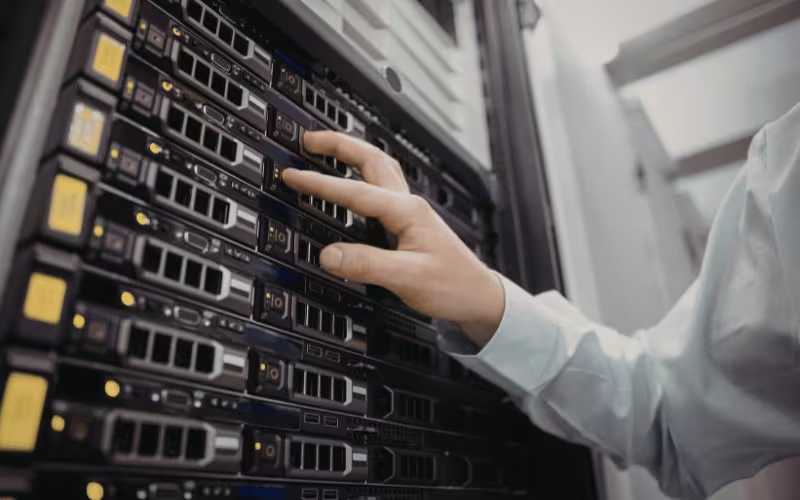
Servers form the invisible backbone of our modern digital infrastructure. They power massive cloud computing networks, run complex artificial intelligence algorithms, and store the critical data that keeps global businesses operational. As organizations generate more data than ever before, the demand for robust, high-performance hardware continues to skyrocket. Meeting this demand requires exceptional engineering and a relentless focus on progress.
The companies designing and building these enterprise machines operate at the absolute frontier of technology. Their success relies heavily on pushing the boundaries of continuous innovation, maximizing computational performance, and prioritizing environmental sustainability. Without their hardware, the digital services we rely on daily would simply cease to exist.
In this comprehensive guide, we will explore the leading server companies shaping the IT industry. We will dive deep into how innovative server technologies drive current market trends and examine the trailblazing organizations setting new standards for the future. You will learn about key players revolutionizing data centers, discover their most cutting-edge product lines, and understand how their aggressive sustainability initiatives are reducing global electronic waste.
Innovative Server Technologies Driving Industry Trends
The landscape of enterprise computing is constantly shifting, driven by innovative technologies that dictate broad industry trends. Advanced server architectures sit at the very center of this evolution. High-performance computing clusters now feature incredibly dense processor configurations and sophisticated thermal management systems. These cutting-edge designs allow data centers to process massive artificial intelligence workloads without succumbing to thermal throttling or system failure. Energy-efficient designs also play a crucial role. Modern facilities must balance immense processing power with strict power-consumption limits, pushing hardware manufacturers to engineer far more efficient power supplies and advanced liquid-cooling mechanisms.
Dell Technologies stands out as a prominent leader driving these critical industry trends. The company consistently delivers cutting-edge server solutions that pair extreme processing capabilities with intelligent, automated management software. Dell recognizes that raw power means very little if administrators cannot manage the hardware efficiently. Furthermore, Dell places a massive focus on sustainability. Their engineering teams design hardware that maximizes performance per watt, helping massive data centers significantly reduce their overall energy consumption and lower operating costs.
Hewlett-Packard Enterprise (HPE) represents another major force dictating server technology trends. HPE excels at developing highly scalable, uniquely modular server systems. Their architecture allows businesses to purchase exactly the computing power they need today, with the flexibility to easily snap in additional processing nodes or storage arrays as their requirements grow. This modularity prevents businesses from overprovisioning hardware.
Staying ahead of market demands requires these companies to invest heavily in aggressive research and development. The hardware demands of machine learning and big data analytics change almost monthly. By prioritizing continuous R&D, companies like Dell and HPE anticipate future bottlenecks and engineer advanced solutions long before enterprise customers even realize they need them. This proactive approach to hardware engineering is exactly what keeps the entire IT industry moving forward at such a rapid pace.
Trailblazing Companies Shaping the Future of Servers
Several trailblazing organizations are currently shaping the future of enterprise hardware through relentless innovation and a deep commitment to sustainable manufacturing. These companies do not just react to market changes; they actively create the frameworks that define modern computing.
Dell Technologies consistently leads the charge with its incredibly innovative server designs. The company pairs top-tier processing components with an overarching commitment to eco-friendly practices. Dell heavily focuses on AI-driven server management. Their proprietary software utilizes machine learning algorithms to monitor hardware health, predict component failures before they happen, and automatically adjust cooling fans to match real-time thermal loads. This intelligent automation creates highly energy-efficient solutions that drastically reduce manual maintenance for IT administrators. By integrating AI directly into the hardware management layer, Dell sets a high benchmark for operational reliability.
Hewlett Packard Enterprise (HPE) holds a commanding position as the leader in modular and scalable server systems. HPE understands that modern businesses do not operate exclusively in private data centers. Therefore, they place a massive emphasis on hybrid cloud solutions and edge computing. Their servers are specifically engineered to bridge the gap between local, on-premises hardware and expansive public cloud networks. HPE also builds ruggedized servers designed to process data at the “edge”—locations like remote manufacturing plants or telecommunications towers where immediate data processing is vital, and standard data center infrastructure cannot survive.
Lenovo has also established itself as a formidable trailblazer in the global hardware market. The company is renowned for engineering high-performance servers specifically tailored for artificial intelligence and massive big data applications. Lenovo builds machines that can easily accommodate multiple heavy-duty enterprise graphics cards, providing the parallel processing power required to train complex AI models. Beyond pure performance, Lenovo places a strict focus on extreme hardware reliability. Their global reach and robust supply chain ensure that multinational corporations can deploy identical, highly dependable server clusters in data centers worldwide.
Key Players Revolutionizing the Server Industry
While some companies focus on broad market dominance, other key players revolutionize the server industry through highly specialized infrastructure and advanced enterprise integration. These organizations provide the foundational hardware that supports our most critical global networks.
IBM stands as the ultimate pioneer in enterprise server solutions. While they have shifted much of their focus toward software and services, their hardware division continues to push the boundaries of artificial intelligence and quantum computing. IBM is globally recognized for its incredibly robust mainframe systems. These massive machines handle the highest-volume transaction processing for the world’s largest banks, airlines, and retail corporations. Furthermore, IBM excels at deep cloud integration, allowing legacy mainframe architecture to communicate seamlessly with modern, agile cloud applications. Their hardware represents the pinnacle of data security and absolute operational uptime.
Cisco Systems has completely revolutionized how we think about the intersection of networking and server infrastructure. Traditionally, companies purchased servers and networking switches as entirely separate entities. Cisco changed the paradigm by creating hyper-converged infrastructure. Their data center solutions tightly weave computing power, network routing, and data storage into a single, unified system. This brilliant approach drastically simplifies data center deployments. IT administrators can manage the entire stack through a single software interface, vastly reducing network complexity and eliminating the compatibility issues that often plague multi-vendor environments.
Supermicro has quietly become a dominant force by specializing in highly customizable and uniquely energy-efficient server solutions. Unlike companies that sell rigid, pre-configured boxes, Supermicro builds hardware using a “building block” methodology. They offer thousands of different motherboards, chassis, and cooling configurations. This allows enterprise clients to design servers tailored to their exact workload requirements. Supermicro has leveraged this extreme customization to build a massive presence in the cloud provider and enterprise markets. Their ability to deliver customized, highly efficient hardware at an incredible scale makes them an indispensable player in the modern data center industry.
Cutting-Edge Products and Solutions from Top Server Companies
The theoretical innovations developed by these leading organizations eventually take physical form as some of the most impressive hardware on the planet. The flagship product lines from these top companies represent the pinnacle of modern engineering.
The Dell PowerEdge server line remains one of the most popular and trusted hardware families in the world. IT professionals universally recognize PowerEdge servers for their exceptional scalability, raw processing performance, and incredible energy efficiency. Dell offers these machines in various form factors, ranging from compact 1U rack servers for basic web hosting to massive, GPU-dense towers built for deep learning. The integrated iDRAC management controller allows administrators to deploy, update, and monitor these servers remotely with absolute ease.
HPE ProLiant servers offer an equally impressive array of cutting-edge solutions. The ProLiant family places a massive focus on seamless hybrid cloud integration. HPE designs these servers to operate securely within hybrid environments, ensuring data moves safely between local storage and public cloud providers. They also feature advanced AI-driven management through HPE InfoSight, which constantly analyzes system telemetry to optimize performance and prevent bottlenecks.
Lenovo ThinkSystem servers are masterfully designed for high-performance computing and complex big data analytics. Lenovo engineers these machines to maximize memory bandwidth and minimize data latency, which is absolutely critical when processing massive datasets in real-time. Their Neptune liquid cooling technology allows ThinkSystem servers to run high-wattage processors without generating excessive acoustic noise or heat.
IBM zSystems represent the most advanced mainframe architecture available for enterprise applications. These machines offer unmatched cryptographic security, capable of encrypting massive volumes of data at the hardware level without slowing down transaction speeds.
Finally, the Cisco UCS (Unified Computing System) combines advanced networking capabilities directly with powerful server nodes. By integrating the network fabric directly into the server chassis, Cisco UCS streamlines operations, reduces cabling complexity, and provides administrators with unparalleled control over their virtualized environments.
Sustainability and Environmental Initiatives in Server Manufacturing
As the global demand for computing power grows, the environmental impact of data centers has become a critical concern. The leading server companies now recognize that raw performance must not come at the expense of our planet. They have implemented aggressive sustainability and environmental initiatives to dramatically alter how they manufacture and manage enterprise hardware.
Dell Technologies leads the industry with a fierce focus on reducing its total carbon footprint. The company achieves this through highly energy-efficient server designs that require less electricity to operate and cool. Furthermore, Dell champions robust hardware recycling programs. They actively recover precious metals and plastics from retired servers, integrating these reclaimed materials directly into their new product lines to create a closed-loop manufacturing cycle.
HPE has made a massive, public commitment to achieving net-zero greenhouse gas emissions across its entire value chain. To reach this ambitious goal, HPE prioritizes the use of renewable energy sources across its manufacturing facilities. They also design their servers to be easily disassembled at the end of their lifecycle, ensuring that toxic components do not end up in global landfills.
Lenovo actively drives green manufacturing practices across its global supply chain. The company utilizes innovative low-temperature solder technology in circuit board assembly, drastically reducing the energy required in the manufacturing process. Lenovo also makes extensive use of recycled packaging materials and ocean-bound plastics, proving that enterprise hardware can be both powerful and environmentally responsible.
Cisco Systems focuses heavily on developing highly energy-efficient servers that help data centers lower their daily power consumption. Cisco also spearheads aggressive initiatives to reduce global e-waste. They offer comprehensive take-back programs, encouraging enterprise clients to return aging hardware for secure data wiping and responsible recycling. Emphasizing sustainability remains absolutely vital for the IT sector to meet urgent global environmental goals.
Why These Companies Are Industry Leaders
Achieving dominance in the global server market requires much more than simply assembling fast computer parts. The organizations discussed above maintain their positions as industry leaders through a relentless combination of strategic vision and flawless execution.
First and foremost, you can highlight their unwavering commitment to innovation, sustainability, and absolute customer satisfaction. These companies do not rest on their previous successes. They pour billions of dollars into research and development to solve complex thermal dynamics, optimize data throughput, and secure hardware against sophisticated cyber threats. Their dedication to sustainability demonstrates their understanding of broader corporate responsibilities, earning the long-term trust of environmentally conscious enterprise clients.
Furthermore, their ability to adapt to changing market demands and rapid technological advancements separates them from legacy hardware builders. When artificial intelligence sparked a massive demand for GPU-dense architectures, companies like Dell, Lenovo, and Supermicro rapidly pivoted their engineering resources to deliver optimized solutions. When businesses began moving workloads to the edge of the network, HPE and Cisco delivered ruggedized, compact systems tailored for remote deployment. This supreme agility ensures they always have the exact hardware solutions that the market desperately needs.
Ultimately, these companies maintain their leadership by actively driving the future of server technology and physical infrastructure. They dictate the standards for remote management, define the limits of energy efficiency, and build the physical foundation of the modern internet. Their hardware empowers medical research, secures global financial networks, and brings advanced artificial intelligence to life.
Conclusion
The enterprise hardware market relies heavily on the brilliance and dedication of the world’s top server companies. Throughout this guide, we explored the innovative technologies, aggressive sustainability efforts, and cutting-edge product solutions offered by industry giants like Dell Technologies, HPE, Lenovo, IBM, Cisco, and Supermicro. By pushing the boundaries of thermal management, hybrid cloud integration, and unified computing, these organizations empower businesses to process data faster and more securely than ever before.
Their impact on vital industries like cloud computing, artificial intelligence, and global telecommunications cannot be overstated. Without their reliable hardware, our digital economy would grind to a halt. Looking forward, the future of the server industry appears incredibly bright. As the demand for advanced machine learning and edge computing accelerates, these leading companies will undoubtedly continue to shape the global IT landscape, building the sustainable, high-performance infrastructure required to support the next great technological revolution.
