


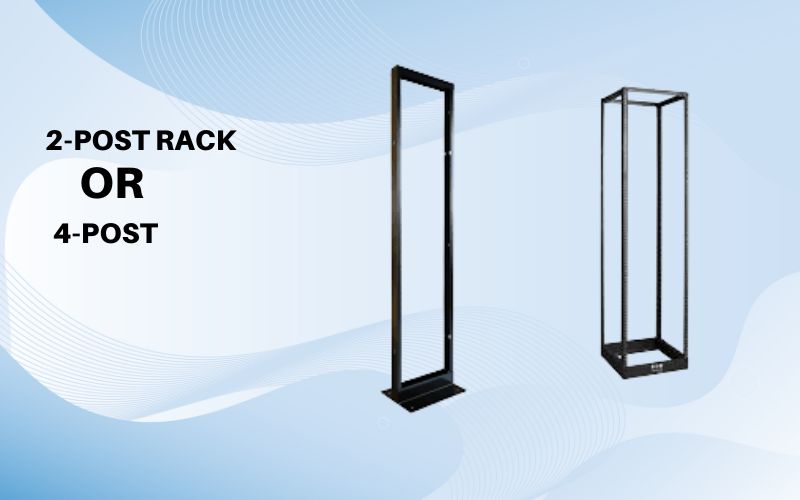
Know the difference between 2-post and 4-post racks to better inform your choice between these essential data center storage options. The march toward optimizing all your IT infrastructure offers facility managers many options, but makes selecting the best enclosure a bit more complex. Where a buyer may once have chosen between a simple shelf and a basic cabinet for their office, there is now the added consideration of weight capacity, footprint, and compatibility with equipment. Two such structural options—2-post and 4-post racks—have considerable overlap but are suited to very different uses, environments, and buyers. Understanding the core differences between these two fundamental rack designs can help you make the right choice that best fits your specific network needs, maximizing both your physical space and your overall budget. We will explore the structural pros and cons of each rack type to guide your final decision and ensure your equipment stays safe.
What Are 2-Post Racks?
While more and more data centers use heavy-duty enclosures, 2-post racks take the simple route, relying on a single pair of vertical uprights that must be bolted down to remain stable. Sometimes referred to as relay racks or telco racks, they feature a basic open-frame design that securely holds lightweight equipment to get your network up and running. The primary components attach in the center or flush to the front, balancing the load directly across the two main posts.
The main physical advantage of a 2-post rack is its complete absence of bulky exterior panels in the local server room where it operates. In almost all cases, they also drastically cut the amount of floor space they require, but that depends on how the cabling is routed, which can range from neat overhead trays to a messier floor layout. Crucially, when such open-frame racks are utilized in high-density telecom closets, every square inch effectively becomes more usable. On the practical side, a 2-post rack has a much smaller footprint than a full cabinet with heavy doors, and it provides instant access, resulting in brisk (and often addictive) maintenance speeds. They are also incredibly cost-effective and simpler to assemble, and give off a clean, utilitarian vibe as a result.
That said, server components are heavy, and a larger, fully loaded chassis further increases weight, making long-depth servers and battery backups comparatively tough to mount (which they don’t currently support without extra brackets), and they tend to cause bending or instability under an unbalanced load. This is mostly a future consideration for those who purchase heavy enterprise servers, because a standard 2-post rack’s structural integrity is truly designed for lightweight switches and patch panels. There is also the physical impact of exposed cables to consider, as many of the cords that go into these open frames require intricate management, but these impacts are lessening as cable organizers improve.
Why Choose 4-Post Racks?
Four-post racks are sometimes thought of as the best of both worlds when it comes to stability and access, packaging an open-frame layout with four solid vertical posts that can provide immense support when hooked together, support heavy loads through four-point mounting, and house deep equipment with or without extra shelves. The user decides which combination of mounting rails is best for the current hardware conditions, so you may smoothly transition from shallow network switches to massive database servers.
But the combination of a four-point mounting system and deep structural bracing makes for a robust infrastructure. Most 4-post racks rely on a sturdy square or rectangular frame to hold the equipment, with the front and rear vertical posts providing secure rack-mount points and augmenting structural rigidity by adding stability, or by letting you mount slide rails for efficient maintenance. This design drastically improves weight distribution across the floor, easily handling the heaviest enterprise-grade servers, redundant power supplies, and massive storage arrays without breaking a sweat.
Compared to 2-post options, 4-post racks have a significantly larger footprint, requiring more floor space to accommodate the bulky hardware portion of your deployment in large server rooms, so the financial impact of their purchase is comparatively higher, yet they still provide unmatched versatility. There are variations on that theme, chief among them the enclosed server cabinet, which adds lockable doors and swaps in side panels for extended security and directed cooling between routine maintenance visits. They cost more to ship, purchase, and construct, but they offer the structural guarantee needed for expensive, mission-critical hardware.
Which Rack is Right for You?
Two-post racks, especially the aluminum or steel relay sort, are a great space-saving option for those interested in organizing simple telecom closets but not yet sold on the massive footprint of a heavy-duty data center. A 2-post rack lets you dabble in basic network setups, both at small branch offices and in dedicated wiring closets, while still providing that structural safety net for lightweight switches and routers, or for times when you just cannot find enough floor space to fit a full-sized cabinet. If you work in a tight utility room or are in the early stages of building a business network, a traditional 2-post rack that does not consume excessive depth will give you the flexibility you may need while still being cleaner and more organized than stacking gear on a desk.
When you are ready to mount heavy, full-depth enterprise servers, the expanding array of available 4-post racks offers stability-minded and capacity-oriented options, as well as some that double-duty for complex cable management. A 4-post rack is the undisputed champion for housing large server chassis, heavy uninterruptible power supplies, and deep storage appliances that require four-point support. Choice can sometimes be overwhelming, but whether you need the sleek efficiency of a 2-post relay rack or the heavy-duty muscle of a 4-post frame, there is an ideal structural foundation for everyone in the rapidly expanding future of enterprise IT infrastructure.
