Onechassis

Efficient Rackmount Solutions: Tailored 1U-4U Chassis from a Premier Manufacturer for Enhanced Server Management
Compact Server Case with Hot-Swap Rackmount Storage for Efficient Management
Mining Rig and 8-Bay Hot-Swap Solutions
Advanced Wallmount Chassis: Optimized MINI-ITX Case for Wall-Mounted Desktop Solutions

The OCDS5000B-W Dual Node Server is a high-performance, dual-controller storage solution built on Intel’s advanced platform. Ideal for cloud computing, big data, and enterprise applications, it offers scalability, reliability, and cutting-edge efficiency.

Sleek Aluminum Design, Gaming-Optimized, with Customizable Airflow Options

What is a Rack Server?

Learn what rack servers are, how they work, their benefits, and use cases. Get tips on choosing the right rack server for your business needs.

What is a Rack Server

READ TIME

5 min

Overview of Rack Servers

A rack server is a powerful computer specifically designed for high-density deployment in data centers and enterprise IT closets. Their primary role is to house and run the critical applications and services that businesses rely on, from websites and databases to complex analytics workloads. They form the backbone of modern IT infrastructure, providing the processing power, storage, and connectivity needed to keep operations running smoothly and efficiently in a standardized, scalable format.

These servers are characterized by their compact, low-profile design, which allows dozens of them to be stacked vertically in a specialized frame called a server rack. This approach maximizes the use of physical space while simplifying maintenance and administration. Key features include exceptional scalability, enabling easy expansion of computing resources, and centralized management, which allows IT teams to oversee a large number of servers from a single point of control, ensuring reliability and performance.

Key takeaways

Definition

Discover Rack Servers

At its core, a rack server is a physical server built into a flat, rectangular chassis designed to be mounted, or “racked,” inside a standardized 19-inch server rack. This modular design contrasts sharply with traditional standalone servers, prioritizing density and efficient use of space. By stacking these units vertically, organizations can consolidate a tremendous amount of computing power into a very small footprint. The height of each server is measured in rack units (U), with 1U equaling 1.75 inches, allowing for precise planning and organization within the rack.

Rack servers are the workhorses of the digital world, used to store and process data, host applications, and support a wide range of enterprise workloads. They are built to integrate seamlessly with other rack-mounted infrastructure, such as networking switches, storage arrays, and power distribution units (PDUs). This compatibility creates a cohesive, highly organized ecosystem where all components work together efficiently, sharing power, cooling, and network connectivity within the confines of the rack enclosure, which is essential for building robust and scalable IT environments.

Functionality

How Do Rack Servers Work?

Rack servers are installed in a server rack, where they are secured with screws or rails. Once mounted, they connect to shared resources that serve the entire rack. Power is supplied through centralized power distribution units (PDUs), and network connectivity is provided via top-of-rack switches, which consolidate cabling and simplify network management. Cooling is also managed at the rack level, with data centers employing sophisticated airflow strategies, such as hot-aisle/cold-aisle configurations, to dissipate the immense heat generated by the densely packed hardware.

This consolidated setup is what allows rack servers to support high-density computing so effectively. By centralizing power, cooling, and networking, administrators can manage resources much more efficiently than they could with individual, standalone servers. Remote management tools, often built directly into the servers, enable IT teams to monitor, configure, and troubleshoot all the hardware in a rack from a single console, without needing physical access to each machine. This capability is crucial for allocating resources dynamically and maintaining high availability in large-scale environments.

Differences 

Rack Servers vs. Other Server Types

Compared to tower servers, rack servers differ fundamentally in design and purpose. Tower servers are standalone units resembling desktop PCs, ideal for small businesses with limited needs, as they don’t require specialized racks or cooling. Rack servers, however, are built for scalability and density. While a few tower servers can quickly fill a room, dozens of more powerful rack servers can fit into a single rack, making them the superior choice for growing businesses and data centers that require efficient use of space.

The comparison with blade servers introduces another level of density. Blade servers are even more compact, consisting of modular “blades” that slot into a chassis. This chassis provides shared power, cooling, and networking for all blades, offering the highest possible density. However, this comes at the cost of a higher initial investment in the proprietary chassis and less hardware flexibility than rack servers. Rack servers offer a balance, providing excellent density and scalability while using standardized components that offer greater vendor flexibility.

In summary, rack servers hit a sweet spot for many organizations. They offer a significant upgrade in density and manageability over tower servers, and provide more flexibility and lower entry costs than a full-blade system.

Benefits

Benefits of Rack Servers

Frame 2147223707.png
Scalability

Rack servers are designed for growth. As your computing needs increase, you can easily add more server units to available slots within the rack without a major overhaul of your infrastructure. This “pay-as-you-grow” model allows businesses to scale their resources incrementally and predictably, ensuring they always have the capacity to handle demanding workloads and user growth. This makes them a future-proof investment for any expanding organization.

Frame 2147223707 1.png
Space Efficiency

The compact, stackable design of rack servers is their defining advantage. By housing equipment vertically in a rack, they make the most of valuable data center floor space. A single server rack can hold the equivalent computing power of dozens of bulky tower servers, consolidating hardware into a small, organized footprint. This high-density capability is essential for large enterprises and colocation facilities where every square foot counts and operational efficiency is paramount.

Frame 2147223707 2.png
Centralized Management

Rack servers dramatically simplify IT administration. With all servers, networking gear, and storage housed in a single rack or row of racks, management becomes centralized. Technicians can manage cabling, perform maintenance, and monitor hardware from one location. Furthermore, integrated remote management controllers (such as Dell’s iDRAC or HPE’s iLO) allow administrators to manage every server from a single console, reducing operational complexity and saving significant time and effort.

Frame 2147223707 3.png
High Performance

Rack servers are built to handle intensive tasks. They can be configured with powerful multi-core processors, large amounts of memory, and high-speed storage options like SSDs and NVMe drives. This robust hardware, combined with optimized cooling and power from the rack environment, allows them to sustain peak performance for demanding applications such as virtualization, database management, and high-performance computing without thermal throttling or other bottlenecks.

Frame 2147223707 4.png
Flexibility

Rack servers provide excellent flexibility to support a wide array of applications and use cases. Their standardized form factor means you can mix and match servers from different vendors within the same rack. They can be configured as web servers, database servers, application servers, or virtualization hosts, allowing you to build a versatile infrastructure tailored to your specific business needs.

Frame 2147223707 5.png
Cost Efficiency

While the initial investment can be higher than for a tower server, rack servers offer long-term cost efficiency. By sharing power, cooling, and networking infrastructure, they reduce operational expenses. Efficient data center cooling systems and centralized power management lead to lower energy bills, and the simplified administration reduces the staff hours required for maintenance, ultimately lowering the total cost of ownership.

Types

Types of Rack Servers

1U Rack Servers

A 1U rack server, measuring just 1.75 inches high, offers the highest density in the standard rack-mount form factor. These slim servers are ideal for scale-out applications and lightweight workloads that require a large number of individual nodes, such as web hosting, content delivery networks (CDNs), and front-end application servers. While their compact size limits internal expansion for components like GPUs or extra storage, they provide an excellent balance of computing power and space efficiency.

2U Rack Servers

A 2U rack server is twice the height of a 1U server, measuring 3.5 inches. This extra space allows for greater flexibility and more powerful configurations. 2U servers can accommodate more memory, additional hard drives, and multiple expansion cards, making them a versatile choice for a wide range of workloads. They are often used for virtualization, databases, and general-purpose enterprise applications, offering a strong balance between performance, storage capacity, and space efficiency in the rack.

4U and Larger Rack Servers

Servers that are 4U (7 inches) or larger are designed for maximum performance and storage capacity. The spacious chassis can house multiple processors, extensive amounts of RAM, and a large number of hard drives, making them ideal for the most demanding tasks. Common use cases include high-performance computing (HPC), large-scale virtualization, and storage-intensive applications such as big data analytics and video rendering. These servers trade density for raw power, serving as the heavy-lifters in the data center environment.

How to choose

Choosing Your Rack Server

Selecting the right rack server starts with a clear understanding of your business needs and IT goals. Factors like workload requirements, available space, future growth, and budget all play a significant role in your decision.

Rack servers vary widely in form factor, performance, and scalability—making it important to match your choice to your infrastructure and operational demands. Whether you’re outfitting a small server room or a large-scale data center, a thoughtful approach will ensure your investment truly supports your organization’s requirements.

Steps to choosing the right rack server:

  1. Assess your workload: Consider the types of applications you’ll run and their compute, memory, and storage demands. This will help determine the server size and hardware specifications.
  2. Plan for scalability: Think ahead to future growth. Choose a server and rack system that allows you to add capacity or performance without significant disruption.
  3. Evaluate your budget: Balance the costs of hardware, energy usage, and ongoing maintenance against the server features and performance you need now and in the future.
  4. Check compatibility: Ensure your selected rack server integrates smoothly with existing infrastructure and management tools to reduce complexity during deployment and beyond.
RESOURCES

Discover more resources

Tower Server Vs. Rack Server
Read More
Rack Server vs. Multi Node Server
Read More
Rack Server Maintenance Guide
Read More

Frequently Asked Questions

A rack server is a type of computer server designed to be installed in a standardized server rack. It is compact, stackable, and optimized for space efficiency, making it ideal for environments like data centers. Rack servers are equipped with powerful hardware to handle demanding workloads and are often used in enterprise IT setups. Unlike tower servers, rack servers are designed to save space and allow for centralized management, making them a preferred choice for businesses with multiple servers.

Rack servers and tower servers differ primarily in design and use case. Rack servers are designed to fit into rack enclosures, enabling better space utilization and centralized management in data centers. They are compact and stackable, making them ideal for environments requiring multiple servers. Tower servers, on the other hand, are standalone units resembling desktop computers. They are better suited for smaller setups or businesses with limited server needs, as they do not require a rack for installation and are easier to deploy in non-dedicated server rooms.

Rack servers offer several benefits, including space efficiency, scalability, and centralized management. Their compact design allows multiple servers to be housed in a single rack, saving valuable floor space in data centers. They are also easier to manage and maintain, as all servers are centralized in one location. Rack servers provide better cooling and cable management, ensuring optimal performance and reliability. Additionally, they are highly scalable, making it easy to add more servers as business needs grow, and they integrate seamlessly with other IT infrastructure.

Rack servers are widely used in data centers, enterprise IT environments, and industries requiring high-performance computing. They are ideal for applications such as web hosting, virtualization, database management, and large-scale storage. Businesses rely on rack servers for tasks such as running business-critical applications, supporting cloud computing, and managing big-data analytics. Their scalability and efficiency make them suitable for organizations of all sizes, from small businesses to large enterprises, that need reliable and powerful server solutions.

Choosing the right rack server involves evaluating your specific needs, including workload requirements, performance expectations, and budget. Consider factors such as processor power, memory capacity, storage options, and scalability to ensure the server can handle your current and future demands. Assess compatibility with your existing IT infrastructure and ensure the server supports your organization’s growth plans. Additionally, consider cooling, power consumption, and management features to optimize operational efficiency. Consulting with IT professionals or server providers can help you make an informed decision tailored to your business needs.

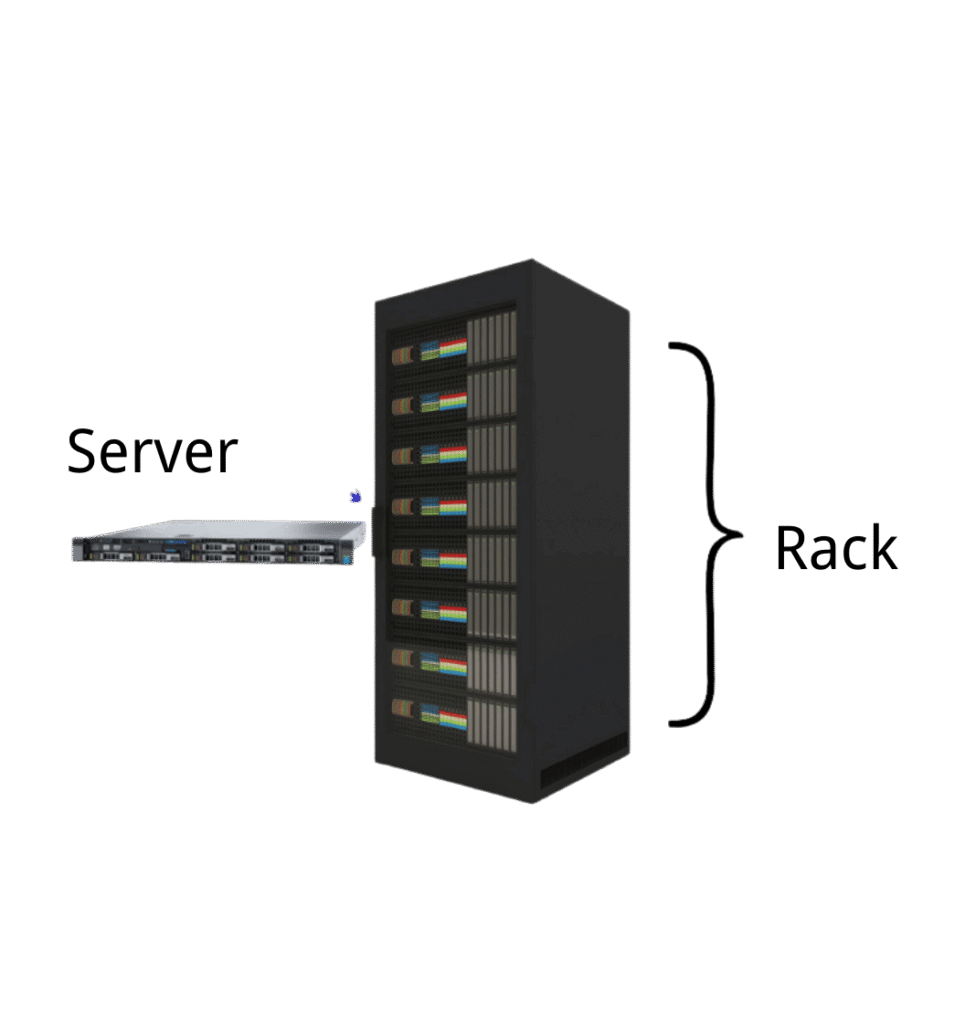
A server is the computer that processes data and runs applications. A rack (or server rack) is a metal frame designed to house multiple servers and other network equipment, such as switches and storage arrays, in an organized, space-efficient manner.

A standard 42U rack can hold up to 42 1U servers, 21 2U servers, or a combination of the two. The ‘U’ is a standard unit of measure for rack-mounted equipment, where 1U equals 1.75 inches.

Yes, because multiple rack servers generate significant concentrated heat in a small area. Data centers use specialized cooling systems, like Computer Room Air Conditioning (CRAC) units, to maintain optimal operating temperatures and prevent hardware failure.

While possible, it is generally not recommended. Rack servers are much louder and generate more heat than a standard desktop. They require adequate ventilation and power, and the noise level can be disruptive in a home or small office environment.

Rack server depths vary, but they are typically designed to fit in standard server racks, which are often around 36 inches (approx. 914 mm) to 48 inches (approx. 1219 mm) deep. The server itself might be anywhere from 24 to 35 inches deep.

Yes, significantly louder. Rack servers use multiple small, high-speed fans to dissipate a large amount of heat within a compact chassis. The noise they produce is comparable to that of a vacuum cleaner and is not suitable for a typical office setting.

Get in touch with Us !

Contact Form Demo