


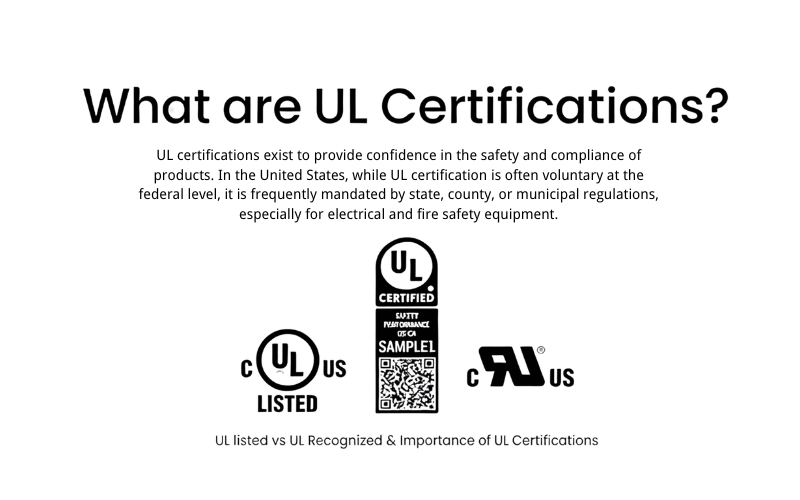
UL certifications are safety standards in the United States for a wide range of products, including electrical appliances, machinery, and equipment. The organization behind them, Underwriters Laboratories (UL), was founded in 1894 as a non-profit, non-governmental safety science company. Today, the UL enterprise develops standards, and UL Solutions conducts product testing and certification. These certifications signify that a product has been tested to nationally recognized safety and sustainability standards. The scope is broad, covering everything from industrial control panels to consumer electronics, ensuring they are safe for public and workplace use.
Purpose of UL Certifications
UL certifications exist to provide confidence in the safety and compliance of products. In the United States, while UL certification is often voluntary at the federal level, it is frequently mandated by state, county, or municipal regulations, especially for electrical and fire safety equipment. Many industries and retailers also require UL certification as a prerequisite for market entry. The core purpose is to validate that electrical, mechanical, and other products meet stringent safety requirements, thereby protecting consumers and workers from potential hazards such as electric shock and fire. Therefore, for many product categories, obtaining UL certification is a practical necessity.
Relationship Between UL Certifications and U.S. National Standards
UL standards are developed through a consensus-based process and are often recognized as American National Standards (ANSIs). While these standards begin as voluntary, they are widely adopted into law by various jurisdictions. National codes, such as the National Electrical Code (NEC), reference UL standards, making compliance with them a de facto legal requirement for many installations. When a UL standard is adopted as a U.S. national standard, it is often designated with a prefix like “ANSI/UL.” This integration means that adhering to UL standards is crucial for complying with U.S. laws and regulations at the national, state, and local levels.
UL Standards and CSA Standards
UL standards are primarily for products sold in the United States market. Conversely, CSA standards are for products in Canada. However, a Mutual Recognition Agreement (MRA) exists between Underwriters Laboratories Inc. (UL) and the CSA Group. This agreement allows for products certified by UL for the Canadian market (bearing a C-UL Mark) to be recognized as meeting CSA standards. Similarly, products certified by CSA for the U.S. market are recognized as meeting testing standards equivalent to UL’s, although they are not technically UL-conforming products.
Classification of UL Standards
UL Standards are broadly classified into several key categories to cover a wide array of products and industries. These major groupings include: (1) Electrical and Electronic Products, (2) Life Safety and Security, (3) Building and Construction Materials, (4) Industrial Control Equipment, (5) Plastics and Components, (6) Wire and Cable, (7) Energy and Power Technologies, and (8) Environmental and Public Health. Within these classifications, UL has developed and published over 1,500 standards that address the specific safety requirements and testing protocols for countless products, from smoke detectors to industrial machinery.
Classification of UL Certifications
UL provides different types of certifications, or “Marks,” based on the product and its intended use. The primary categories are shown below.
◎ UL Listed: This is for stand-alone products that have been tested and found to meet UL’s safety standards for a specific category of equipment. These are typically consumer-ready products.
◎ UL Recognized: This mark is for components or materials intended for use within a larger UL Listed product. It certifies that the component meets specific safety and performance criteria.
◎ UL Classified: This mark applies to products evaluated for a specific property, a limited range of hazards, or for use under specific conditions.
SMC components often fall under the UL Recognized category.
UL Standards Related to Electrical Safety
UL standards for electrical safety are extensive, with key documents forming the basis for product design and installation across the U.S. These standards work together to create a comprehensive safety framework.
UL 508A Industrial Control Panels
This standard provides the safety requirements for industrial control panels. It covers aspects such as proper component use, wiring practices, and enclosure specifications, ensuring the panels can be safely installed and operated in an industrial environment.
UL 50 Enclosures for Electrical Equipment
Part of a larger series, this standard details the construction and performance requirements for electrical enclosures. It ensures that enclosures provide the necessary protection against environmental hazards such as dust and water, in accordance with NEMA ratings.
UL 489 Molded-Case Circuit Breakers
This is the standard for circuit breakers, which are crucial safety devices that protect electrical circuits from overcurrent damage. It sets requirements for their performance and reliability.
UL 98 Enclosed and Dead-Front Switches
This standard applies to switches used for general use and for motor circuits, ensuring they operate safely and can disconnect power when needed.
UL 845 Motor Control Centers
This standard covers the requirements for motor control centers, which are assemblies of one or more enclosed sections that contain motor control units.
SMC’s valves, when used in relevant assemblies, adhere to standards such as UL 429, Electrically Operated Valves.
Affixing the UL Mark and Relation with CSA
The U.S. and Canada facilitate unified certification through their Mutual Recognition Agreement (MRA). UL is recognized as a Nationally Recognized Testing Laboratory (NRTL) by the U.S. Occupational Safety and Health Administration (OSHA) and is also accredited by the Standards Council of Canada (SCC) as a certification organization (CO) and testing organization (TO). This dual recognition allows UL to test and certify products for compliance with Canadian (CSA) standards. Likewise, CSA is recognized by OSHA as an NRTL and can test and certify products to U.S. standards.
Products tested by UL for compliance with CSA standards receive the C-UL Mark. Products tested by CSA for compliance with UL standards receive the CSA NRTL mark.
SMC has had CSA concurrently assess conformity to both CSA and UL standards, thereby obtaining recognition for both markets. The CSA NRTL/C mark on the product nameplate indicates this dual certification.
Conclusion
UL certifications represent a critical pillar of product safety in the United States and beyond. For manufacturers, they are essential for demonstrating due diligence, meeting regulatory requirements, and gaining access to markets. For consumers and workers, the UL Mark assures that a product has been rigorously tested to meet established safety standards, reducing the risk of fire, electric shock, and other hazards. Adhering to UL standards is not just about compliance; it is a fundamental commitment to safety and quality that benefits everyone.
Read More: What are ETL Certifications?
