


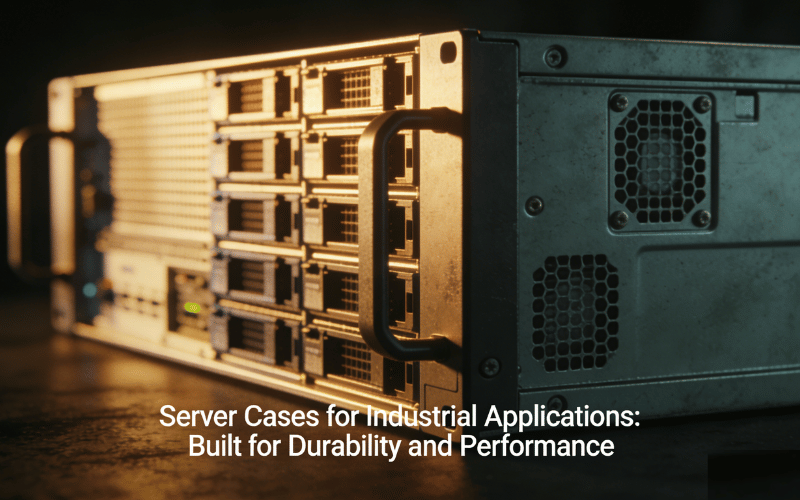
Server cases play a critical role in industrial applications, where reliability and durability are paramount. These specialized enclosures are designed to protect sensitive components from harsh environmental conditions, such as extreme temperatures, dust, and vibrations, ensuring uninterrupted performance.
In this article, we will explore the key features and benefits of industrial server cases, as well as the essential criteria to consider when selecting the proper case for your specific needs. By understanding these factors, you can make informed decisions to enhance the reliability and efficiency of your industrial systems.
What Exactly is an Industrial Server Case?
An industrial server case is a robust enclosure designed to house and protect critical server components in demanding operational environments. Unlike standard server cases used in controlled office spaces, an industrial server case is designed to withstand intense heat, shock, dust ingress, and other rigorous conditions often encountered in data centers, manufacturing floors, and remote installations. They are deployed to secure processing power across various sectors. Industrial server systems are frequently utilized in heavy industry. They are fabricated from resilient materials such as cold-rolled steel or galvanized alloys and often incorporate advanced thermal management, including high-velocity blowers or liquid cooling support. The case also provides stable anchoring points for internal hardware, such as the backplane, power supply units, RAID arrays, and riser cards, enabling integration of additional functionality.
Industrial server cases are indispensable elements of enterprise computing infrastructure used for a broad spectrum of tasks, including cloud storage, network security, big data analytics, artificial intelligence, and edge computing. These units are generally built for continuous uptime and demand superior standards of stability and endurance. The industrial server case plays a crucial role in protecting the delicate circuitry inside from external hazards and ensuring consistent operation over extended lifetimes. When considering the industrial server case, we must not overlook the importance of rackmount compatibility.
How Do Industrial Server Cases Differ from Standard Server Cases?
Industrial server cases are engineered and constructed for high reliability and extended operational life, setting them apart from standard server cases. A standard server case is generally intended for use in climate-controlled data centers or server rooms. Industrial settings are significantly more challenging, demanding a far more resilient solution. Standard server cases are not specifically built to handle the rigors of industrial environments. Here’s how they differ:
- Durability: Industrial cases are fabricated from heavy-duty materials such as thick, cold-rolled steel or aluminum alloys to withstand demanding conditions, including physical shock, heavy vibration, and temperature fluctuations. Standard server cases are often made from lighter-gauge materials and are more vulnerable to physical damage. They are not specifically designed for harsh environments.
- Environmental Protection: Industrial cases frequently have sealed designs with gaskets and filters to guard against dust, moisture, and corrosive agents. They may also include specialized EMI shielding. Standard server cases provide only basic protection against these environmental factors.
- Cooling Mechanisms: Industrial environments can expose equipment to extreme heat. Industrial cases often integrate advanced cooling solutions, such as high-pressure blowers, redundant fan configurations, or even liquid cooling systems to manage thermal loads effectively. Standard server cases rely on conventional fans, which may be inadequate in high-temperature industrial settings. Industrial servers are designed to operate reliably at higher temperatures.
- Mounting Options: Industrial cases provide diverse mounting capabilities, including rackmount, wallmount, or embedded configurations, to accommodate various installation needs in factories or field locations. Standard server cases are designed almost exclusively for 19-inch rack installation in a data center.
In summary, an industrial server case is a hardened enclosure designed to deliver a high degree of protection and reliability for server hardware operating in demanding industrial or non-traditional environments.
Key Features of a Robust Industrial Server Case
A robust industrial server case is defined by several essential features that empower it to protect and sustain the reliable function of server components in high-stress environments:
- Durable Construction: As noted, heavy-gauge materials such as reinforced steel or aluminum are fundamental. The case’s architecture must be engineered to endure shock, physical impacts, and persistent vibration without compromising the structural integrity of the internal hardware. The case is built for longevity.
- Environmental Sealing: Comprehensive sealing against dust, particulates, moisture, and other foreign matter is critical. This typically involves the use of industrial-grade gaskets, replaceable filters, and protective coatings on exterior surfaces.
- Efficient Cooling Solutions: Industrial settings can reach extreme temperatures. A resilient server case will integrate robust cooling systems, such as high-static pressure fans, logically positioned air vents, substantial heat sinks, or even direct liquid cooling in specific configurations. Fanless passive cooling designs are also prevalent for particular use cases where airborne particulates or moving parts are a concern.
- Flexible Mounting Options: The ability to install the case in multiple orientations—such as standard rackmount, wallmount, or custom panel mount—provides vital adaptability for diverse deployment scenarios. An integration engineer can select the optimal method.
- Expansion Capabilities: Industrial server applications often require specialized accelerator cards such as GPUs or FPGAs. A quality industrial case will offer sufficient PCIe expansion slots to house these essential cards.
- Secure Component Mounting: Internal hardware, including the server motherboard, backplanes, storage arrays, and power supplies, must be securely fastened to nullify the risk of damage from vibration or shock.
- Wide Operating Temperature Range: The case, and the hardware it contains, must be certified for a broad operating temperature range to function reliably in both extreme heat and cold.
These characteristics collectively ensure that the industrial server system within the case can operate dependably and uphold its performance levels under challenging conditions.
Benefits of Rackmount Server Cases in Industrial Settings
Rackmount server cases are a preferred choice for industrial deployments because of their substantial advantages:
- Space Optimization: Rackmount server cases are engineered to fit standard 19-inch racks, enabling highly efficient use of floor space in control rooms, data closets, or equipment cabinets. Numerous rackmount systems can be stacked vertically, maximizing compute density.
- Standardization: The universal 19-inch rack standard guarantees compatibility and interoperability with equipment from a wide range of manufacturers. This rack-mount standard simplifies component exchange or upgrades.
- Scalability: It is straightforward to increase compute or storage capacity by simply installing additional rackmount cases into the rack. This design allows industrial server infrastructures to expand seamlessly as operational requirements grow.
- Cable Management: Racks provide an organized framework for routing power and data cables, minimizing clutter and simplifying system maintenance and troubleshooting.
- Cooling Efficiency: Rackmount server cases are built for optimized airflow within the rack enclosure. Typically, cool air is drawn in from the front and hot air is expelled from the rear, which helps maintain safe operating temperatures for all components. They can also be fitted with industrial-grade, redundant power supplies.
- Accessibility: Components inside a rackmount server case are generally easy to access from either the front or rear of the rack, streamlining service, maintenance, and hardware upgrades.
- Security: Server racks can be outfitted with locking doors and side panels to prevent unauthorized physical access to the hardware, a critical consideration for mission-critical industrial systems. The industrial rackmount is a secure option.
Rackmount server cases come in various heights, which are measured in rack units (U). A 1U case is 1.75 inches high, a 2U case is 3.5 inches high, a 4U case is 7 inches high, and so on. The selection of a specific rackmount case height is determined by the compute, storage, and expansion requirements of the application.
Why is Thermal Management Crucial for Industrial Server Cases?
Effective thermal management is paramount in industrial server design because these environments often operate at high ambient temperatures, and excessive heat can significantly degrade the performance and reliability of electronic components. These industrial servers are engineered to operate within a wide temperature range.
- Component Reliability: Elevated temperatures can accelerate the degradation of electronic components, leading to premature failures. CPUs, GPUs, power supplies, and storage devices are especially vulnerable to heat-related damage.
- Performance Degradation: As components heat up, they may engage in thermal throttling, automatically lowering their clock speeds to avert overheating. This can result in a substantial decrease in system performance.
- System Stability: Uncontrolled heat can lead to system-wide instability, manifesting as crashes, freezes, or spontaneous reboots, which is unacceptable for mission-critical applications.
- Data Integrity: Overheating increases the risk of data corruption or outright data loss, particularly on storage drives such as SSDs and HDDs.
- To mitigate these risks, industrial server cases and systems utilize several thermal management strategies:
- High-Airflow Fans: Powerful, high-static-pressure fans are deployed to draw cool air into the case and forcibly exhaust hot air. Redundant and hot-swappable fan configurations are common.
- Heat Sinks and Fanless Designs: Heat sinks, typically made of aluminum or copper with fins to maximize surface area, are affixed to heat-producing components to dissipate heat more effectively. In some applications, fanless designs are used to eradicate moving parts and prevent dust accumulation, relying on large, passive heat sinks and natural convection.
- Liquid Cooling: For high-density, high-performance industrial server systems, liquid cooling can be implemented to remove heat from processors and accelerators more efficiently than traditional air cooling.
- Thermal Monitoring: Integrated sensors actively monitor the temperatures of critical components. System management firmware can then dynamically adjust fan speeds or issue alerts if temperatures breach pre-defined safe operating limits.
Meticulous thermal management is non-negotiable for guaranteeing the long-term reliability, consistent performance, and operational stability of industrial server systems. The industrial server case plays an indispensable role in this process.
How to Choose the Right Industrial Server Case for Your Needs
Selecting the right industrial server case is crucial for ensuring the reliability and longevity of your industrial server infrastructure. Here are some key factors to consider:
- Environment: Assess the specific environmental conditions where the server will operate. Consider factors such as temperature extremes, dust, debris, moisture, vibration, and the potential for physical impacts. This will determine the level of ruggedization and sealing required.
- Application Requirements: Understand your application’s performance needs. This will influence the choice of CPU, motherboard, storage arrays, and expansion slots needed. Consider whether you need a high-performance cluster for complex analytics or a storage-dense server for data archiving.
- Mounting: Determine how the case will be mounted. Rackmount is ideal for server rooms or equipment cabinets, while wallmount or desktop options might be better for space-constrained field offices or control rooms.
- Size and Form Factor: Choose a case size and form factor (e.g., 1U, 2U, 4U rackmount) that accommodates your server board, drive bays, and other components while fitting within the available rack space.
- Cooling: Select a cooling solution appropriate for the thermal environment and the heat generated by the components. Consider high-static-pressure fans, advanced air ducts, or liquid cooling compatibility based on your thermal density.
- Expansion: Ensure the case has enough expansion slots (PCIe) to accommodate any specialized add-in cards required for your application (e.g., RAID controllers, high-speed network cards, or GPUs).
- I/O Connectivity: Verify that the case supports the necessary I/O interfaces for your peripherals and networking needs (e.g., multiple Ethernet ports, serial consoles, USB management ports).
- Power Supply: Choose a power supply that meets the wattage requirements of your components and is rated for industrial use. Look for features like redundancy (1+1 or N+1) to ensure uptime during power faults.
- Budget: Industrial server cases can range in price depending on their features and ruggedness. Determine your budget and find a solution that meets your technical requirements without overspending.
- Vendor Reputation: Select a reputable manufacturer known for producing high-quality industrial server hardware and providing excellent customer support.
By carefully considering these factors, you can choose the right industrial server case to ensure reliable operation of your industrial server system, even in the most challenging environments.
Latest Trends in Industrial Server Cases
The field of industrial servers and cases is constantly evolving to meet the escalating demands of modern industrial applications. Here are some of the most significant technology trends:
- Edge Computing and AI: As more data processing shifts from centralized data centers to the network edge, there is a surging need for compact, powerful, and rugged servers designed for edge deployments. These systems often feature support for high-performance GPUs and AI accelerators to handle complex machine learning and inference workloads in real time.
- Enhanced Connectivity: Industrial servers are increasingly integrating advanced connectivity options, such as 5G, Wi-Fi 6, and multi-gigabit Ethernet (10GbE/25GbE), to support high-bandwidth data transfer and low-latency communication required for IoT and industrial automation.
- Modular and Blade Designs: Modular industrial servers and blade chassis are gaining traction due to their superior flexibility, scalability, and serviceability. Users can easily swap out compute, storage, or networking modules to adapt to changing application needs or perform upgrades with minimal downtime.
- Cybersecurity: With the heightened threat of cyberattacks on critical infrastructure, there is a greater focus on embedding security features directly into industrial server hardware and cases. This includes features like hardware-based root of trust, Trusted Platform Modules (TPMs), and physically secure, lockable case designs.
- Sustainability and Energy Efficiency: There is a growing emphasis on energy efficiency in industrial computing to reduce operational costs and environmental impact. Manufacturers are designing server cases with highly efficient, redundant power supplies and optimized thermal designs that consume less power.
- Miniaturization and High-Density: The trend toward smaller and more compact yet powerful industrial servers continues, driven by space constraints at the edge and the need for high-density compute solutions. Industrial server cases are also becoming smaller and more lightweight while still providing robust protection and advanced features.
These trends reflect the ongoing evolution of industrial server technology to address the challenges of increasingly complex, data-intensive, and interconnected industrial environments.
Summary
Here are the 10 most important things to remember about industrial server cases:
- Industrial server cases are specialized, rugged enclosures designed to protect critical server components in harsh operational environments.
- They are built with durable materials, offer comprehensive environmental sealing, and integrate advanced cooling mechanisms to ensure reliability.
- Rackmount server cases provide space optimization, standardization for compatibility, seamless scalability, and efficient cooling in rack-based industrial deployments.
- Key features include robust construction, environmental sealing, efficient thermal management, versatile mounting options, and extensive expansion capabilities for components like GPUs.
- Effective thermal management is crucial in industrial server design to ensure component reliability, maintain performance, and guarantee system stability under heavy loads.
- Industrial server cases differ significantly from standard cases in durability, environmental protection, cooling capacity, and mounting flexibility.
- Choosing the right industrial server case involves considering factors such as the specific environment, application requirements, mounting options, size, cooling, expansion, I/O, power supply, budget, and vendor reputation.
- The latest trends in industrial server cases include support for edge computing and AI, enhanced connectivity like 5G, modular designs, and improved energy efficiency.
- These cases are essential for ensuring the reliable, 24/7 operation of industrial server systems by protecting sensitive hardware from extreme conditions.
- The selection of an appropriate industrial server case is a foundational step in building a resilient and long-lasting industrial computing infrastructure.
