


A sudden power supply failure can be catastrophic for critical systems. In an instant, it can trigger system downtime, cause irreversible data loss, and even physically damage sensitive equipment. This is where redundant power supplies become essential. If you have ever wondered what a redundant power supply is, this guide will explain everything you need to know. We will explore what this technology is, how it works, and the different types available, showing how it ensures continuous operation and protects valuable systems from unexpected power disruptions.
What is a Redundant Power Supply?
A redundant power supply is a system that includes multiple power supply units (PSUs) within a single piece of equipment, such as a server or network switch. Its primary role is to ensure continuous operation by providing a backup power source if one of the primary units fails. When all PSUs are functioning correctly, they typically share the electrical load, which improves efficiency and reduces wear. If one PSU fails, another instantly takes over the full load without interrupting the connected device.
The definition of a redundant power supply goes beyond just backup; it is about building high availability and fault tolerance directly into the hardware. Power from a single source is not always stable or uninterrupted. A redundant system mitigates the risk of a single point of failure within the power delivery chain. Without it, the failure of a single PSU would cause the entire system to crash, leading to significant problems like data corruption and hardware failure. Businesses that depend on uninterrupted service, such as data centers, hospitals, and industrial control systems, rely on redundant power supplies to avoid costly disruptions.
Redundant Power Supplies Sold On Amazon:
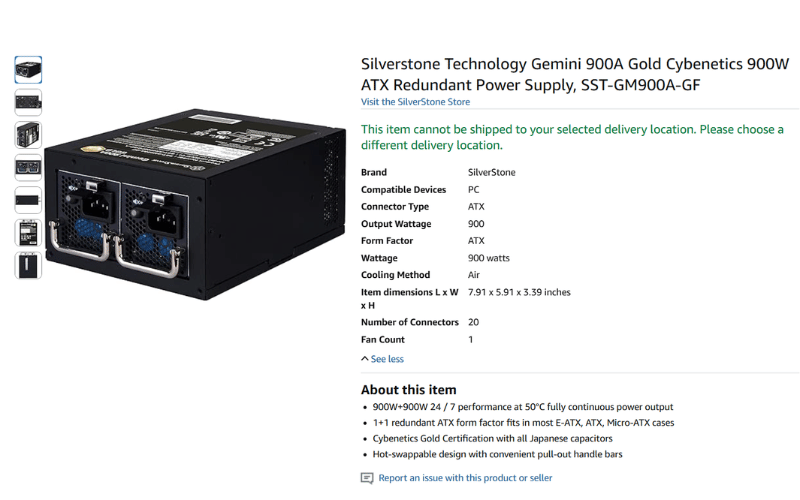
Parameter:
| Parameter | Details |
|---|---|
| Compatible Devices | PC |
| Connector Type | ATX |
| Output Wattage | 900 |
| Form Factor | ATX |
| Wattage | 900 watts |
| Cooling Method | Air |
| Item Dimensions (L x W x H) | 7.91 x 5.91 x 3.39 inches |
| Number of Connectors | 20 |
| Fan Count | 1 |
Types of Redundant Power Supply Systems
There are several types of redundancy, each designed for different applications and levels of reliability.
N+1 Redundancy
This configuration is a common approach to achieving high availability. “N” represents the number of power supply units required to power the system’s full load. The “+1” signifies one additional, independent PSU installed as a backup. During regular operation, all N+1 units share the load. If one unit fails, the remaining N units are sufficient to handle the full load without interruption. It is ideal for critical systems where reliability is essential, but budget constraints are also a consideration, offering a good balance between cost and resilience.
2N Redundancy
Think of this as a fully mirrored system. A 2N configuration comprises two complete, independent power systems, each capable of powering the entire load on its own. It effectively duplicates the “N” number of required PSUs. For example, if a system requires two PSUs (N=2), a 2N setup would have four PSUs arranged in two separate systems. If one entire power system fails, the other takes over completely. This level of redundancy is used in high-availability environments such as enterprise data centers, where any downtime is unacceptable.
2(N+1) Redundancy
This is one of the most robust and fault-tolerant configurations available. It combines the features of both N+1 and 2N redundancy. The system comprises two fully independent N+1 systems. This means there are two separate power systems, and each has an extra backup PSU. This advanced setup provides multiple layers of protection, safeguarding against both individual component failure and the failure of an entire power distribution path. It is reserved for mission-critical applications where maximum reliability is non-negotiable.
How Does a Redundant Power Supply Work?
A redundant power supply system is a critical feature in servers, networking equipment, and other mission-critical devices designed to ensure continuous operation. Its fundamental purpose is to eliminate a single point of failure by providing an alternative power source that can take over instantly if the primary source fails. Unlike a single-power-supply system, a redundant configuration ensures that a hardware failure or loss of one power circuit does not cause a complete system shutdown. This setup is essential for maintaining high availability in data centers and enterprise environments where even a few moments of downtime can be costly.
When discussing how a redundant power supply works, it is essential to consider how its core components and principles function together to deliver uninterrupted power:
Power Supply Units (PSUs)
A redundant system includes two or more identical Power Supply Units (PSUs) within a single device. In a typical N+1 configuration (where ‘N’ is the number of PSUs required to power the device), there is at least one extra PSU than needed. For example, a server that requires one PSU to run will be equipped with two. Both units are connected to power and are operational simultaneously. This arrangement ensures that if one PSU fails due to an internal component issue or a cut to its external power source, the other PSU is already running and can instantly handle the device’s full electrical load without interruption.
Load Balancing
In many modern redundant systems, the multiple PSUs actively share the electrical load. This is known as load balancing or load sharing. Instead of having one PSU operate at full capacity while the other sits idle, the system intelligently distributes the power draw between them. For instance, in a system with two PSUs, each might operate at 50% of its capacity. This approach is more efficient, as PSUs often run most effectively when not pushed to their maximum limit. It also reduces wear and tear on the individual components, prolonging the lifespan of both power supplies and generating less heat.
Automatic Failover
The core of a redundant system is its ability to perform an automatic and seamless failover. Each PSU is constantly monitored. If one unit stops providing the correct voltage—whether due to a component failure, a tripped circuit breaker, or a disconnected power cord—the system detects the anomaly in milliseconds. The remaining PSU (or PSUs) immediately and automatically assumes the entire electrical load of the device. This transition is instantaneous, and the server or network switch continues to operate without any disruption, service interruption, or data loss. The end-user experiences no downtime.
Monitoring and Control
Sophisticated monitoring and control systems are integral to the reliability of a redundant power supply. These systems, often integrated into the server’s management interface (such as IPMI or iDRAC), constantly monitor the health and status of each PSU. They monitor input voltage, output power, temperature, and fan speed. If an issue is detected, such as a PSU failure or a loss of input power, the system will generate an alert—often an audible alarm, a blinking LED on the chassis, and a notification sent to the system administrator. This allows for prompt replacement of the faulty unit, which is often hot-swappable, meaning it can be changed without powering down the device.
Factors to Consider When Choosing a Redundant Power Supply
Choosing the proper redundant power supply depends on various technical and operational factors. Here are some key considerations:
Power Requirements
Understanding your precise power needs is essential. You must calculate the total power load of all connected components—such as CPUs, GPUs, and storage drives—and select a power supply system that can handle at least 25% more than your current peak load. This headroom ensures stability during power spikes and accommodates potential hardware additions. Overloading a power supply can lead to inefficiency, overheating, and system instability, defeating the purpose of redundancy.
Redundancy Level
Select a configuration based on the level of protection required.
- N+1 Redundancy: Suitable for standard enterprise environments, this configuration provides one extra power supply module beyond what is needed to support the load. If one fails, the spare takes over.
- 2N Redundancy: Provides fully mirrored protection with two completely independent power systems. This is ideal for mission-critical environments where absolutely zero downtime is acceptable.
- 2(N+1) Redundancy: Offers the highest level of reliability by combining mirroring with extra backup modules, designed for ultra-critical infrastructure like Tier IV data centers.
Scalability
Consider modular systems that allow for future expansion. As your IT infrastructure grows, your power demands will increase. A scalable redundant power supply system allows you to add more power modules to the existing chassis without replacing the entire unit. This flexibility ensures that your power infrastructure can adapt to new hardware requirements efficiently, protecting your initial investment and reducing long-term costs.
Efficiency
Look for systems with high energy efficiency to reduce operational costs. Power supplies are rated by efficiency standards such as 80 Plus (Bronze, Silver, Gold, Platinum, Titanium). Higher-rated units convert more wall power into usable energy for your components and generate less heat as waste. In a redundant setup with multiple units running simultaneously, opting for Platinum- or Titanium-rated supplies can result in significant electricity savings and lower cooling requirements over time.
Monitoring Features
Ensure the system includes real-time monitoring and alert capabilities. A robust, redundant power supply should be compatible with management protocols such as SNMP or IPMI. This allows administrators to remotely track input/output voltage, current, fan speed, and temperature. Crucially, it should send immediate alerts in the event of a module failure or power loss, enabling IT staff to replace the faulty unit quickly before the backup redundancy is compromised.
Compatibility
Verify that the power supply is compatible with existing equipment and infrastructure. This goes beyond just physical dimensions (form factor). You must ensure the connectors match your server’s motherboard and components, and that the input voltage matches your facility’s power distribution units (PDUs). Additionally, check whether the power supply firmware integrates smoothly with your server management software to ensure accurate reporting and control.
Benefits of Redundant Power Supply
A redundant power supply is essential for safeguarding critical infrastructure against unexpected hardware failures and electrical issues. It ensures continuous operation, preventing costly downtime and maintaining business continuity. Understanding the value of redundancy helps in designing resilient systems for your organization’s needs. Whether for enterprise servers, networking gear, or data centers, a redundant power supply provides a fail-safe mechanism, ensuring productivity and system integrity, and investing in redundancy guarantees enhanced reliability and long-term protection for mission-critical operations.
FAQs
What is the purpose of a redundant power supply?
The primary purpose of a redundant power supply is to ensure continuous power delivery to a critical device, like a server or network switch. Having at least one backup power supply unit (PSU) ready to take over instantly prevents a single PSU failure from causing system downtime. This design eliminates a common point of failure, guaranteeing that the equipment remains operational even if one power unit malfunctions.
How does a redundant power supply differ from a UPS?
A redundant power supply protects against the failure of an internal component (the PSU itself). In contrast, a UPS (Uninterruptible Power Supply) protects against an external power problem, such as a blackout or voltage surge. A redundant power supply uses multiple PSUs within one device for internal failover. In contrast, a UPS is an external device that provides temporary battery backup to the entire system when the primary power source from the wall is lost. They often work together for maximum protection.
Where are redundant power supplies commonly used?
Redundant power supplies are standard in any environment where uptime is critical. This includes data centers, which host servers and networking equipment that must run 24/7. They are also vital in hospitals for life-support systems, in industrial control systems for manufacturing processes, and in financial institutions for transaction processing. Essentially, any mission-critical system that cannot afford unexpected shutdowns benefits from power supply redundancy.
Are redundant power supplies energy-efficient?
Yes, modern redundant power supplies are designed for high efficiency. They often carry 80 Plus ratings (such as Gold, Platinum, or Titanium), which certify that they waste very little energy as heat. In many systems, the power load is balanced across multiple PSUs, allowing each unit to operate in its most efficient range. This not only minimizes energy waste and reduces electricity costs but also contributes to a cooler operating environment, further enhancing system reliability.
How do I choose the right redundancy level?
Choosing the right redundancy level depends on balancing reliability needs against budget. For most businesses, an N+1 configuration, which provides one spare PSU, offers a great mix of protection and cost-effectiveness. For mission-critical applications where any downtime is unacceptable, a 2N (fully mirrored) or even 2(N+1) configuration provides higher fault tolerance. You should assess your system’s criticality, potential downtime costs, and power requirements to make the right choice.
Conclusion
A redundant power supply is a fundamental component for protecting critical systems from unexpected failures. It ensures continuous operation, preventing costly downtime, data loss, and equipment damage. Understanding what a redundant power supply is and its different types helps you choose the right system for your needs. Whether for a single server or an entire data center, investing in a reliable power supply provides long-term reliability and the peace of mind that comes from knowing your systems are protected.
