


Edge computing is a distributed computing paradigm that brings computation and data storage closer to data sources. Its primary purpose is to process data locally rather than sending it to a centralized cloud. This approach is designed to improve response times and save bandwidth. Moving compute resources to the “edge” of the network, where data is generated, enables faster, more efficient operations.
The rapid growth of the Internet of Things (IoT) has created a massive influx of data that needs to be processed in real time. Businesses are adopting edge computing to handle this data deluge effectively. For applications like autonomous vehicles, industrial automation, and augmented reality, even a millisecond of delay can be critical. Edge computing addresses this need for speed by minimizing latency, allowing for instantaneous decision-making and action without relying on a distant cloud server.
This guide will provide a comprehensive overview of edge computing, starting with a comparison to traditional cloud computing. We will explore how it works, its key benefits, and prominent use cases across various industries. Furthermore, we will discuss hardware solutions that power edge deployments, address common challenges, and answer frequently asked questions to provide a complete picture of this transformative technology.
Edge Computing vs. Cloud Computing
Cloud computing operates on a centralized model, where data from various sources is sent over the internet to massive data centers for processing and storage. This architecture provides enormous scalability and processing power, making it ideal for big data analytics, large-scale application hosting, and long-term data archival. However, its reliance on a central location means that data must travel long distances, which can introduce significant delays, or latency. This makes it less suitable for applications that require immediate feedback.
Edge computing, in contrast, decentralizes data processing. Instead of sending all data to the cloud, it performs computational tasks at or near the physical location where data is created. This could be on the IoT device itself, a local gateway, or a small, nearby server. By processing data locally, edge computing drastically reduces latency and minimizes the amount of data that needs to be sent over the network. This approach conserves bandwidth and ensures that time-sensitive operations can continue even with an intermittent internet connection.
The primary advantage of edge computing shines in scenarios where real-time processing is non-negotiable. For example, an autonomous vehicle cannot wait for a remote server to decide whether to apply the brakes; that decision must be made instantly. Similarly, industrial sensors monitoring critical machinery need to trigger immediate alerts upon detecting an anomaly. While the cloud is excellent for intensive, non-urgent analysis, the edge excels at providing the necessary instantaneous response for modern IoT and autonomous systems to function safely and effectively.
How Does Edge Computing Work?
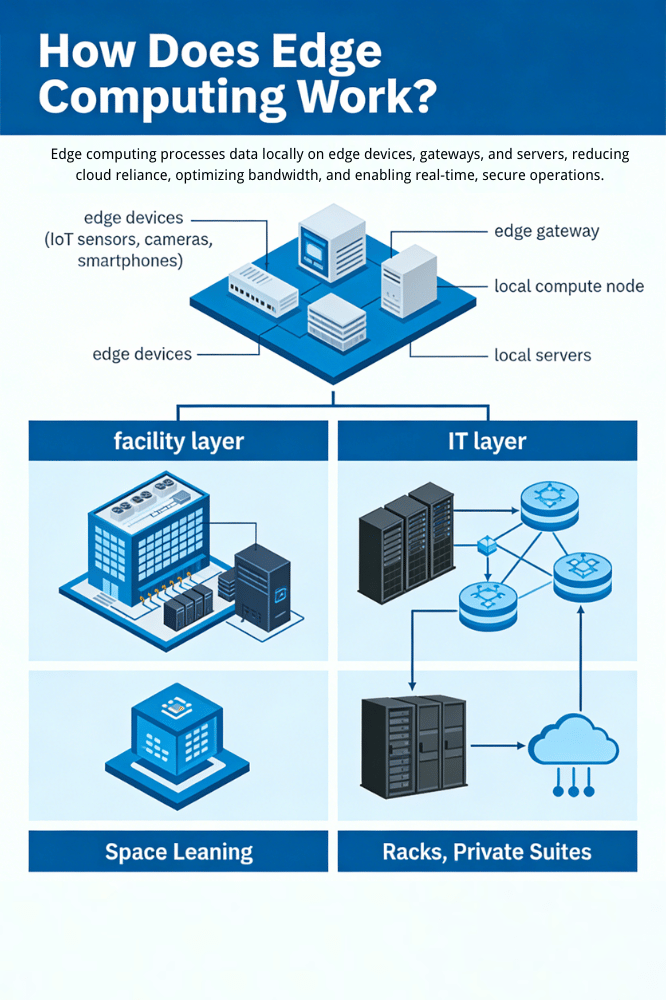
The operational model of edge computing revolves around a distributed network of devices and local servers. It begins with “edge devices,” such as IoT sensors, security cameras, or smartphones, which generate data. This data is then captured by an “edge gateway” or a local compute node situated physically close to these devices. This gateway acts as an initial processing point, filtering, analyzing, and acting on the data in real time. This localized processing is what enables the near-instantaneous response times characteristic of edge applications.
By handling data at the source, edge computing significantly reduces the need to transmit large volumes of raw data to centralized cloud servers. Only essential information, such as summary data, analytical results, or alerts, is sent to the cloud for long-term storage or further, more complex analysis. This selective data transmission optimizes network bandwidth, lowers data transfer costs, and improves overall system efficiency. It also ensures that applications can function reliably even when network connectivity to the cloud is unreliable or unavailable.
Local servers and dedicated edge nodes are crucial components for ensuring data security and operational reliability. These servers, often located in a factory, retail store, or cell tower, provide a more robust environment for processing than the edge devices themselves. They can aggregate data from multiple devices, run more complex analytics, and enforce security policies locally. By keeping sensitive data on-site, edge computing enhances privacy and reduces the attack surface, as the data does not have to traverse public networks to be processed.
Key Benefits of Edge Computing
The most significant benefit of edge computing is the dramatic reduction in latency. By processing data at its source instead of sending it to a distant cloud, the delay between data generation and action is minimized to just a few milliseconds. This enables accurate real-time data processing, which is critical for applications like autonomous driving, remote surgery, and industrial robotics. This immediate feedback loop allows systems to react instantly to changing conditions, improving both safety and performance.
Edge computing significantly improves efficiency and reduces bandwidth usage. IoT devices can generate enormous amounts of data, and transmitting all of it to the cloud is often impractical and expensive. By processing data locally, edge systems can filter out irrelevant information and send only valuable insights to the cloud. This approach drastically reduces network traffic, lowering bandwidth costs and alleviating congestion on corporate networks, making the entire system more efficient and cost-effective.
Beyond speed and efficiency, edge computing offers enhanced security, cost savings, and improved scalability. Keeping sensitive data on-premises reduces the risk of interception as it travels over public networks. This is especially important for industries like healthcare and finance. Furthermore, by reducing reliance on cloud resources for every computation, organizations can lower their operational cloud costs. Scalability is also improved, as new edge nodes can be added incrementally to support more devices without overhauling the central infrastructure.
Edge Computing Use Cases
Edge computing is transforming the Internet of Things (IoT) across both consumer and industrial sectors. In smart homes, edge devices like smart speakers and security cameras can process voice commands and recognize faces locally, ensuring privacy and faster response times. In industrial IoT (IIoT), sensors on factory equipment use edge computing to monitor machinery in real time, predict maintenance needs, and prevent failures before they happen. This predictive maintenance minimizes downtime and improves operational efficiency on the factory floor.
Autonomous vehicles are heavily reliant on edge computing to operate safely. A self-driving car generates terabytes of data per day from its sensors, including cameras, LiDAR, and radar. It is not feasible to send this data to the cloud for processing; decisions about braking, steering, and navigating obstacles must be made in a fraction of a second. Edge computers inside the vehicle process this sensor data locally to make critical, real-time driving decisions, ensuring the safety of passengers and pedestrians.
The development of smart cities and advancements in healthcare are also being propelled by edge computing. In smart cities, edge nodes process data from traffic cameras and sensors to manage traffic flow, optimize public transit, and enhance public safety in real time. In healthcare, wearable devices and remote patient monitoring systems use edge computing to analyze vital signs and alert medical staff instantly to emergencies. This enables proactive care and continuous health monitoring outside a traditional hospital setting.
Edge Computing Solutions
Edge computing deployments, though distributed, often rely on robust, rack-mounted hardware located in local data closets, cell towers, or regional micro-data centers. Onechassis provides a range of industrial-grade products, including Rackmount Cases, Server Cases, and GPU Server Cases, specifically designed for these unique environments. These chassis protect sensitive electronics from dust and vibration while ensuring they fit within standard rack configurations, enabling powerful compute capabilities right where they are needed at the edge.
To support the diverse needs of edge computing, Onechassis offers solutions like compact 1U to 4U Server Chassis for general-purpose compute and larger 4U to 10U GPU Server Cases for AI and machine learning workloads. Edge applications, particularly those involving video analytics or AI inference, require significant processing power. These GPU-ready cases are designed with superior cooling efficiency to handle the heat generated by high-performance processors. For the most demanding deployments, Liquid-Cooled GPU Server Cases provide optimal thermal management, ensuring peak performance without throttling.
Efficient deployment and maintenance are critical in managing a distributed edge infrastructure. Onechassis solutions are designed to simplify these processes. Features such as tool-free installation, organized cable-management pathways, and optimized airflow designs help reduce deployment times and make servicing easier. By using durable, well-designed chassis, organizations can build reliable, high-performing edge nodes that are easy to manage, even in remote or challenging locations, ensuring the success of their edge strategy.
Challenges of Edge Computing
One of the primary challenges of edge computing is security. With processing distributed across thousands of geographically dispersed devices, the attack surface expands dramatically. Each edge node represents a potential entry point for malicious actors. Mitigating this risk requires a comprehensive security strategy that includes robust data encryption both at rest and in transit, strict access controls, and secure device onboarding processes to ensure that only authorized devices can connect to the network.
The complexity of managing a distributed infrastructure also poses a significant challenge. Unlike a centralized cloud environment, edge deployments require monitoring, updating, and maintaining a vast number of nodes across multiple locations. This complexity necessitates the use of advanced automation and orchestration tools. These platforms are essential for deploying software updates, managing configurations, and efficiently monitoring the health of the entire edge network, without requiring manual intervention at each site.
Data management is another hurdle. Ensuring data consistency between edge devices and the central cloud can be difficult, especially with intermittent connectivity. Organizations must develop clear strategies for what data is processed at the edge, what is sent to the cloud, and how to synchronize it all. This involves careful planning around data lifecycle management to avoid data silos and ensure that the insights generated at the edge are effectively integrated into the broader business intelligence ecosystem.
Frequently Asked Questions
What is the difference between edge computing and cloud computing?
Edge computing processes data locally, near the source, for low latency. Cloud computing processes data in centralized data centers, offering massive scale. They often work together, with the edge handling real-time tasks and the cloud handling large-scale analytics.
How does edge computing improve latency?
By eliminating the round-trip journey data must take to a distant cloud server, edge computing reduces processing delays from hundreds of milliseconds to just a few. This enables near-instantaneous response times for critical applications.
What industries benefit the most from edge computing?
Manufacturing, autonomous transportation, healthcare, retail, and telecommunications benefit greatly. Any industry that relies on real-time data from IoT devices to make immediate decisions can leverage edge computing to improve efficiency and safety.
Is edge computing secure?
It can be, but it presents new challenges. While processing data locally reduces exposure on public networks, each edge device is a potential vulnerability. Robust security measures, including encryption and access control, are essential.
Can edge computing work with existing cloud infrastructure?
Yes, a hybrid approach is the most common model. Edge computing complements the cloud by handling time-sensitive processing locally while sending summarized or less critical data to the cloud for long-term storage and analysis.
Conclusion
Edge computing represents a fundamental shift in how we process data, moving computation from centralized clouds to the network’s periphery where data is created. This decentralized approach delivers key benefits, including ultra-low latency, reduced bandwidth consumption, enhanced security, and improved operational efficiency. From powering smart factories and autonomous vehicles to enabling real-time healthcare monitoring, its use cases are rapidly expanding across industries, unlocking new possibilities for innovation.
As the number of connected devices continues to skyrocket, the role of edge computing in modern IT infrastructure will only grow in importance. It is not a replacement for the cloud but rather a critical partner that complements it. When adopting edge solutions, organizations should focus on their specific latency and processing needs to design a hybrid architecture that leverages the best of both worlds. By doing so, they can build a faster, more resilient, and more intelligent system ready for the future.
