


Choosing the right commercial rackmount case is one of those decisions that looks straightforward on paper—until you’re staring down a wall of options with conflicting specs, inconsistent reviews, and a budget that isn’t going to stretch forever.
Whether you’re managing a data center, building out a studio setup, or deploying field equipment, the case you choose directly affects performance, accessibility, and the lifespan of your gear. A poor fit means wasted rack space, poor airflow, and equipment that’s difficult to service. A great fit means clean cable management, reliable protection, and hardware that runs cooler and lasts longer.
This guide cuts through the noise. We’ve reviewed five of the best commercial rackmount cases available in 2026, compared their key specs, and outlined exactly what to look for before you buy. By the end, you’ll have a clear picture of which case fits your setup—and why.
What Is a Commercial Rackmount Case?
A commercial rackmount case is a structured enclosure designed to house and organize rack-mounted equipment—servers, networking gear, audio/visual hardware, power distribution units, and more. Built to EIA rack dimensions (typically 19 inches wide), these cases allow multiple equipment units to stack vertically within a single, unified frame.
The “U” measurement you’ll see throughout this guide refers to rack units, where 1U equals 1.75 inches of vertical space. A 4U chassis, then, gives you 7 inches of usable height—enough for servers, drives, and cooling systems to coexist in an organized, accessible format.
Beyond just holding hardware, a well-designed rackmount case serves several critical functions:
- Thermal management: Proper airflow channels keep components cool under sustained workloads
- Physical security: Lockable panels and robust construction protect sensitive equipment
- Cable organization: Internal routing keeps connections tidy and serviceability high
- Portability or permanence: Some cases are built for fixed rack installations; others are ruggedized for transport
The best commercial rackmount cases balance all of these functions without forcing trade-offs you didn’t agree to.
First Decision: 2U, 4U, or Custom Rackmount Cases?
Before evaluating individual products, you need to decide on the rack unit size. This single choice shapes everything else—from internal capacity to compatibility with existing rack infrastructure.
| Feature | 2U Rackmount | 4U Rackmount | Custom Rackmount |
|---|---|---|---|
| Height | 3.5 inches | 7 inches | Variable |
| Drive bays | Up to 8 | Up to 24+ | Configurable |
| Cooling capacity | Moderate | High | High |
| Best for | Compact setups, edge deployments | Full servers, storage arrays | Specialized or enterprise use |
| Cost | Lower | Mid-to-high | Highest |
2U cases work well when space is at a premium, and your hardware requirements are modest. They’re common in edge computing and small business environments.
4U cases are the workhorses of commercial deployments. More drive bays, better airflow options, and room for full-length expansion cards make them the default choice for serious server builds.
Custom rackmount cases are engineered for specific applications—broadcast production, military field use, and high-density storage. If your requirements fall outside standard configurations, this route offers precision fit at a premium price.
For most commercial environments in 2026, a 4U chassis hits the right balance of capacity and flexibility.
The Best Commercial Rackmount Cases of 2026
1. Supermicro 4U Rackmount Chassis

Best for: High-density server builds
Supermicro’s 4U chassis remains one of the most trusted names in server hardware, and the 2026 lineup continues that reputation. Built with a heavy-gauge steel frame, this chassis supports up to 24 hot-swap 3.5-inch drive bays and accommodates full-length PCIe expansion cards without compromise.
Cooling is handled by multiple high-speed rear fans with a tool-less design that simplifies maintenance during live deployments. Front panel access includes USB 3.0 ports, a power button, and activity LEDs—practical touches that save time during diagnostics.
Compatibility with Supermicro motherboards is seamless, though the chassis also supports third-party ATX configurations. For organizations running high-workload applications—such as virtualization, database hosting, and AI inference—this chassis delivers the thermal headroom and expansion capacity to keep pace.
Standout feature: Hot-swap drive backplane with direct SAS/SATA connectivity reduces downtime during drive replacements.
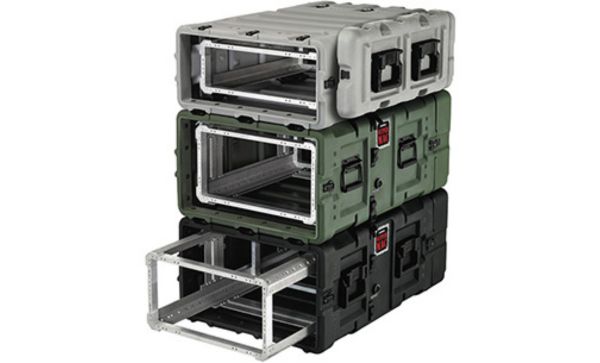
2. Pelican-Hardigg Rack Mount Cases
Best for: Field deployment and transport
Pelican-Hardigg approaches the rackmount category from a different angle. Where most chassis prioritize fixed installation, these cases are engineered for equipment that moves—from broadcast trucks to military field kits to touring AV rigs.
Constructed from high-impact polymer with stainless steel hardware, Pelican-Hardigg cases meet MIL-SPEC standards for drop, vibration, and moisture resistance. Interior foam configurations are customizable, and rack-mount rails can be adjusted to accommodate equipment with varying depths.
The trade-off is weight. These cases are heavier than a steel server chassis of comparable size, which matters if your team is lifting them frequently. But when gear absolutely cannot be damaged in transit, Pelican-Hardigg cases are the industry-standard answer.
Standout feature: Pressure-equalization valves and watertight gaskets protect electronics in extreme environmental conditions.
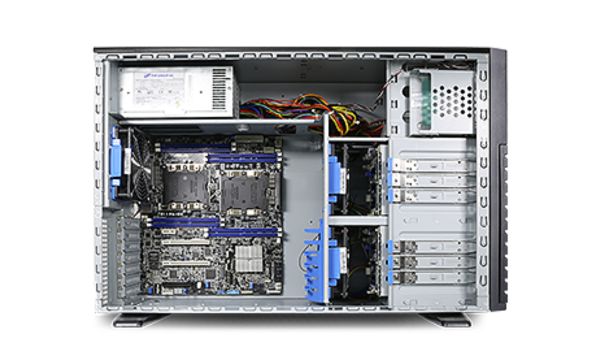
3. Chenbro SR107 Rackmount Chassis
Best for: Industrial environments and high-vibration sites
The Chenbro SR107 Rackmount Chassis is a robust solution designed to meet the demands of challenging industrial deployments. Its all-steel construction ensures exceptional durability, while the vibration-damped design protects sensitive components in high-vibration or dusty environments. This makes it a reliable choice for factory control systems, automation setups, and other rugged use cases.
The chassis supports a variety of configurations, including tool-less trays for quick and easy drive installation. It also accommodates redundant power supply units (PSUs), ensuring uninterrupted operation in mission-critical applications. The thoughtful design extends to its efficient airflow management, with strategically placed vents and fan mounts to maintain optimal cooling under heavy loads.
What sets the Chenbro SR107 apart is its focus on reliability and stability. The chassis is built to withstand harsh conditions, making it a trusted option for environments where standard rackmount cases might falter.
Standout feature: The vibration-damped design and reinforced steel construction make it ideal for industrial applications, ensuring long-term reliability even in the most demanding conditions.
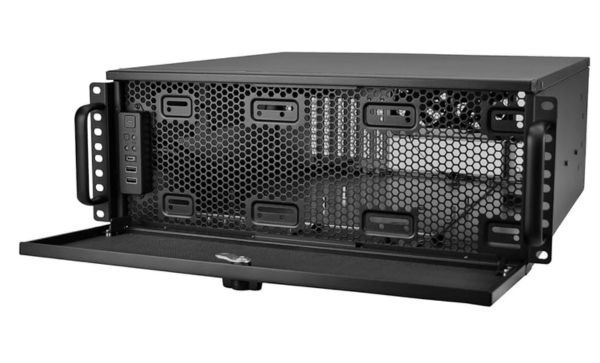
4. Silverstone RM44 4U Rackmount Chassis
Best for: Dense storage arrays
The Silverstone RM44 is purpose-built for storage-heavy deployments. Its front panel fits up to 24 3.5-inch drive bays in a 4U footprint, making it one of the highest-density options on the market without crossing into custom enclosure territory.
Build quality is solid—full steel construction with a powder-coat finish that holds up in rack environments where lesser cases show wear within months. The tool-less drive installation is genuinely quick, which matters when you’re swapping drives across a 24-bay array on a schedule.
Power supply compatibility is broad, supporting standard ATX and redundant PSU configurations. For NAS builds, media storage servers, or backup repositories, the RM44 is difficult to beat at its price point.
Standout feature: 24-bay front-access design with a slim 4U profile—maximizing storage density without requiring a custom chassis.
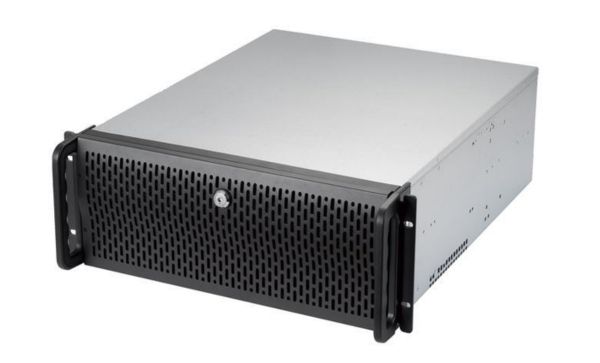
5. Rosewill 4U Rackmount Case
Best for: Budget-conscious builds
Rosewill’s 4U rackmount case is the most accessible entry on this list, and for many straightforward server deployments, that’s exactly what’s needed. The steel chassis supports ATX and E-ATX motherboards, includes eight 5.25-inch drive bays, and ships with rear fan mounts pre-installed.
The build won’t win awards for refinement—panel tolerances are slightly looser than premium options, and cable management requires more deliberate routing. But for teams standing up basic infrastructure on a constrained budget, the Rosewill 4U delivers reliable function at a fraction of the cost of enterprise alternatives.
It also pairs well with off-the-shelf components, making it easy to source replacement parts without proprietary lead times.
Standout feature: Lowest cost-per-U of any case on this list, with broad compatibility across standard consumer and prosumer hardware.
What to Consider When Buying a Rackmount Case
With five strong options reviewed, the right choice ultimately depends on your specific operating environment. Use this buyer’s guide to narrow your decision:
| Consideration | What to Look For |
|---|---|
| Drive bay capacity | Match to current storage needs plus projected growth |
| Cooling & airflow | Fan count, size, and airflow direction relative to your hardware layout |
| Motherboard compatibility | ATX, E-ATX, or proprietary—confirm before purchasing |
| Build material | Steel for fixed installation; polymer/composite for field deployment |
| Hot-swap support | Critical for high-availability environments where downtime is costly |
| PSU configuration | Single vs. redundant power supply support |
| Portability | Fixed rack install vs. transport-ready enclosure |
| Budget | Balance upfront cost against long-term serviceability and compatibility |
One factor worth emphasizing: future-proofing. Purchasing a chassis that meets current needs but has no room for expansion is a common mistake. Buying one size up often costs less than replacing the entire enclosure twelve months later.
Finding Your Best Commercial Rackmount Case for 2026
There’s no one-size-fits-all answer to the best rackmount case—the ideal choice depends on your specific needs, environment, and priorities.
For enterprise-grade storage and high-performance builds, the Supermicro 846 sets the standard with its unmatched cooling and reliability. In rugged field deployments, the Pelican-Hardigg Super-V offers unparalleled durability and protection. The Silverstone RM44 excels in performance workstation setups where noise control is critical, while the Chenbro SR107 shines in industrial environments requiring compact, vibration-resistant solutions. For budget-conscious teams, the Rosewill RSV-L4412U provides excellent value without sacrificing essential features.
The key to finding the right rackmount case is to start with your use case, not just the specifications. Determine whether cooling efficiency, portability, storage capacity, or cost is your primary concern, and let that guide your decision. With the right focus, you’ll find a rackmount case that not only meets your needs but also supports your system’s long-term performance and reliability.
